
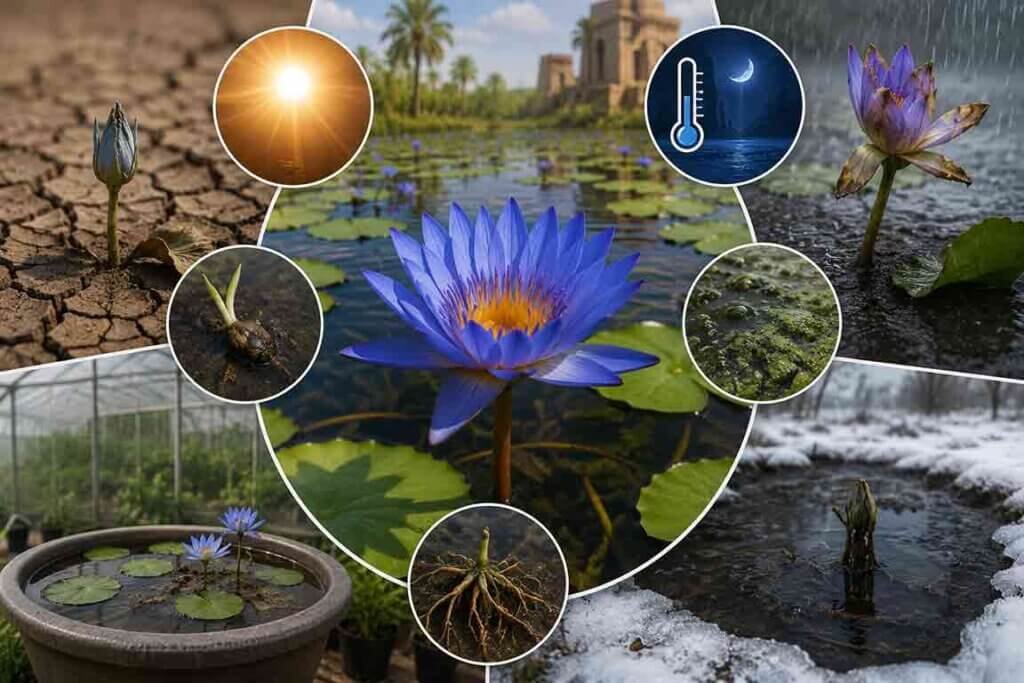
The blue lotus flower, scientifically known as Nymphaea caerulea, is one of the most visually stunning and historically significant aquatic plants on Earth. Revered by ancient Egyptians as a symbol of creation and spiritual rebirth, this striking bloom has captured the imagination of botanists, gardeners, and historians alike for thousands of years. But despite its legendary status and growing popularity in modern horticulture circles, the blue lotus remains notoriously difficult to cultivate outside of its natural habitat. If you have ever tried to grow one and failed, you are far from alone.
So what makes the blue lotus such a demanding and unforgiving plant to grow? The answer lies in a deeply specific set of environmental conditions that this flower has evolved around over millennia. It is not simply a matter of watering it correctly or placing it in a sunny spot. The blue lotus demands an almost precise replication of the Nile River valley and East African wetlands where it naturally thrives. Understanding why it is so hard to grow starts with understanding where it comes from.
What Is the Blue Lotus Flower?
The blue lotus (Nymphaea caerulea) is an aquatic flowering plant native to Egypt, East Africa, and parts of the Indian subcontinent. It belongs to the family Nymphaeaceae and is closely related to common water lilies, though it is culturally and botanically distinct in several meaningful ways. The flower opens in the morning and closes in the afternoon, and its delicate pale blue to violet petals surround a bright yellow center that is immediately recognizable.
In ancient Egyptian art and religion, the blue lotus was everywhere. It appeared on tomb walls, in ceremonial offerings, and in depictions of gods and pharaohs. The Egyptians associated it with the sun god Ra and believed it represented the cycle of life, death, and rebirth. Today, it is also studied for its mild psychoactive compounds, including nuciferine and apomorphine, which contribute to its continued fascination in wellness and ethnobotany communities.
The Difference Between Blue Lotus and Blue Water Lily
Many people confuse the blue lotus with the blue water lily, and this confusion itself causes growing failures. True blue lotus (Nymphaea caerulea) is distinct from the sacred lotus (Nelumbo nucifera) and from standard ornamental water lilies. Its requirements, growth habits, and tolerances are not interchangeable with those related species. When gardeners purchase what they believe is blue lotus and apply general water lily care, the plant often struggles or dies because the specific needs of Nymphaea caerulea are not being met.
The Native Climate of the Blue Lotus
To understand why blue lotus is so hard to grow elsewhere, you first need to understand what “normal” looks like for this plant in the wild. The blue lotus evolved in the warm, slow-moving waters along the Nile River, the edges of Lake Victoria, and similar aquatic environments across tropical and subtropical Africa. These regions share several consistent climate characteristics that the plant depends on entirely.
Temperatures in these zones rarely drop below 15 degrees Celsius (59 degrees Fahrenheit) and frequently hover between 25 and 35 degrees Celsius (77 to 95 degrees Fahrenheit) for the majority of the year. There is abundant sunlight, typically 10 to 12 hours of direct sun daily. The water is warm, often shallow, nutrient-rich, and calm. The air is humid. Seasonal variation exists, but temperatures almost never reach the freezing point, which the blue lotus finds absolutely lethal.
Rainfall and Water Chemistry in Native Habitats
Another critical factor is water chemistry. In its native range, the blue lotus grows in water that tends to be slightly alkaline to neutral in pH, warm from surface sun exposure, and naturally fertilized by the rich sediment and organic matter of river environments. The plant’s roots anchor into muddy, loamy substrate packed with nutrients. This is vastly different from the tap water or well water found in most parts of Europe, North America, or temperate Asia, which may be chlorinated, too cold, or carry the wrong mineral profile entirely.
Why Temperature Is the Number One Enemy
If there is one single reason why blue lotus fails outside its native climate, temperature is it. This plant is deeply tropical. It has no cold-hardiness mechanisms whatsoever. Unlike some hardy water lilies that can survive winter by going dormant under ice, the blue lotus does not have this ability. When water temperatures drop below 15 degrees Celsius, the plant begins to shut down. Below 10 degrees Celsius, the damage becomes severe. Frost is simply fatal.
This means that in the majority of the United States, Canada, Europe, and most of temperate Asia, the blue lotus cannot survive outdoors year-round. Gardeners in USDA hardiness zones 9b through 12 have the best outdoor chances, but even in these regions, a cold snap or an unusually mild summer can ruin an entire growing season. In zones below 9, growing blue lotus outdoors is essentially impossible without heated water features or seasonal relocation.
The Challenge of Indoor Overwintering
Many enthusiasts attempt to bring blue lotus indoors during winter. While this sounds straightforward in theory, it presents enormous practical challenges. The plant still needs abundant direct light, which few indoor environments can provide without powerful grow lights. It needs warm water maintained between 20 and 30 degrees Celsius, which requires aquatic heaters and regular monitoring. Indoor air tends to be dry, particularly in winter when heating systems are running, and the plant prefers humidity. Managing all of these variables simultaneously, while also preventing algae overgrowth and maintaining water quality, is genuinely difficult even for experienced aquatic gardeners.
The Light Requirements Are Exceptionally Demanding
The blue lotus is not a shade-tolerant plant by any stretch of the imagination. In its native habitat, it receives intense, direct equatorial sunlight for the better part of every day. When grown in temperate regions, even in summer, the angle and intensity of sunlight is simply lower than what the plant evolved to handle. Days are shorter, clouds are more frequent, and the UV intensity that drives the plant’s metabolic functions is reduced.
Without sufficient light, the blue lotus produces fewer flowers, or none at all. The leaves may grow, giving the impression that the plant is healthy, but blooming requires far more energy than mere vegetative growth. Growers in northern latitudes often describe growing lush, healthy-looking blue lotus plants that never once produce a single bloom, simply because the light conditions, even in full sun placements, fall short of what the plant truly needs.
Supplemental Lighting and Its Limitations
Some dedicated growers attempt to supplement natural light with full-spectrum grow lights. This can work, but it comes with its own complications. Aquatic plants require light that penetrates the water surface effectively, and standard grow lights positioned above a water feature do not always achieve the necessary light depth and spectrum. High-quality LED grow lights specifically designed for aquatic applications are expensive, consume significant electricity, and still may not fully replicate the quality of tropical sunlight that the blue lotus thrives under in nature.
Soil and Substrate Requirements
The blue lotus is not a plant that will tolerate just any substrate. In the wild, it roots into rich, heavy clay-loam soil that is dense with organic matter, minerals, and beneficial microorganisms. This substrate holds nutrients close to the roots, stays consistently moist, and allows the plant to anchor firmly while its leaves and flowers float at the surface.
Many aquatic gardeners make the mistake of using standard potting soil, which breaks down rapidly underwater, floats free, and clouds the water while depriving the roots of the structural support they need. Alternatively, using gravel or sand alone provides no nutrition. The ideal blue lotus substrate is a blend of heavy clay soil and aquatic plant-specific fertilizer tablets, topped with gravel to prevent dispersal. Replicating the exact mineral and organic composition of Nile river mud in a home garden or container is genuinely difficult to achieve with consistency.
The Role of Fertilization
Because the blue lotus is a heavy feeder in nutrient-rich natural environments, it requires regular fertilization when grown in artificial conditions. However, over-fertilizing promotes algae growth that can overwhelm a small water feature and even suffocate the plant. Under-fertilizing leads to slow growth and poor flowering. Getting this balance right requires experience, regular water testing, and adjustments across the growing season. This is not a set-it-and-forget-it plant.
Water Depth and Movement Considerations
In nature, the blue lotus typically grows in water ranging from 30 to 60 centimeters deep, sometimes reaching up to a meter in certain conditions. The water is generally still or very slow-moving. Strong water movement, such as that created by powerful pumps, fountain jets, or waterfalls, is not something this plant appreciates. The leaves and flowers are designed for calm conditions and will be damaged or prevented from opening properly if the water surface is constantly agitated.
Getting the water depth right in a container or pond also matters more than many growers realize. Too shallow, and the roots overheat and dry out. Too deep, and the leaves cannot reach the surface, and the roots sit in cold layers of water away from the warmth the plant prefers.
Pests and Disease Challenges Outside Native Range
In its native range, the blue lotus exists within a complex ecosystem that includes natural predators of its common pests. Outside that ecosystem, growers can encounter aphid infestations, spider mites in dry indoor environments, leaf-eating beetles, and fungal issues that arise from inconsistent watering or temperature fluctuations. Without the natural balance that exists in African wetland ecosystems, pest control becomes another active responsibility for the grower.
Fungal and Bacterial Issues in Cooler Climates
Cooler temperatures combined with high humidity create perfect conditions for fungal and bacterial infections in blue lotus plants. Root rot is particularly common when water temperatures are lower than ideal, as the plant’s immune response slows and pathogens gain the upper hand. Many growers lose their plants not dramatically or suddenly, but gradually, through a slow rot that begins at the roots and works its way upward through the plant over weeks.
The Seasonal Growth Cycle Problem
The blue lotus follows a growth cycle that is tightly synchronized with the long, hot, sunny seasons of tropical Africa. When it is grown in temperate regions, this cycle gets compressed or disrupted entirely. The growing season in, say, northern Europe or Canada might offer only three or four months of conditions warm enough for the blue lotus to thrive. This is barely enough time for the plant to establish itself, let alone produce the full succession of blooms it would naturally generate across a six to eight month warm season in Egypt or Kenya.
Growers in these regions often find that just as their blue lotus is hitting its stride in midsummer, the temperatures begin to drop in early autumn, cutting the bloom season brutally short. Year after year, this compressed growing window prevents the plant from ever fully expressing its potential or storing enough energy to return vigorously the following year.
Can You Successfully Grow Blue Lotus Outside Its Native Climate?
The honest answer is yes, but with significant effort, investment, and realistic expectations. Growers in tropical and subtropical regions of the world, including parts of Florida, Hawaii, Southern California, the Gulf Coast, South and Southeast Asia, and Australia’s northern territories, have the best chances of outdoor success. In these locations, year-round warmth and long sunny seasons come closest to replicating native conditions.
For growers in temperate zones, success is possible with heated water features, grow lights, quality aquatic soil, careful fertilization, and a commitment to overwintering the plant properly each year. Container growing allows for mobility, letting you move the plant to warm, sheltered locations during cold months. Greenhouses with heated aquatic beds are probably the most reliable solution for temperate-climate growers who are serious about cultivating blue lotus long-term.
Tips That Genuinely Help
Using aquarium heaters to maintain water temperature between 24 and 28 degrees Celsius gives the plant a consistent thermal environment regardless of outdoor conditions. Placing containers in the sunniest possible location, ideally south-facing in the northern hemisphere, maximizes light exposure. Starting with rhizome divisions from healthy, established plants rather than seeds reduces the time to first bloom significantly. Patience is essential because blue lotus can take an entire first season just to settle in before it blooms at all.
Why This Plant Continues to Fascinate Growers Worldwide
Despite all of these challenges, the blue lotus remains a deeply sought-after plant among water garden enthusiasts, ethnobotany hobbyists, and anyone captivated by its historical and cultural significance. There is something uniquely compelling about growing a flower that pharaohs once held sacred, that decorated the walls of Luxor and Karnak, and that has been used in ritual and ceremony for over four thousand years.
The difficulty of growing it, paradoxically, adds to its appeal. When a blue lotus finally blooms in a container on a balcony in Berlin or a greenhouse in Toronto, that flower feels genuinely earned. It is a small triumph of horticultural dedication over climatic adversity. And the bloom itself, that pale blue perfection opening in the morning sun and closing by afternoon, is worth every challenge along the way.
Conclusion
The blue lotus flower is extraordinarily hard to grow outside its native climate because it evolved within a very specific set of conditions that most of the world simply cannot replicate naturally. Warm water year-round, intense equatorial sunlight for ten or more hours daily, rich organic substrate, calm water, high ambient temperatures, and a long frost-free growing season are not conveniences for this plant. They are absolute necessities. When any one of these factors is missing or inadequate, the plant struggles. When several are missing, it fails entirely.
For growers willing to invest in creating artificial tropical conditions through heaters, lights, quality soil, and careful year-round management, blue lotus cultivation is achievable. But it demands respect for what the plant truly needs, not a casual approach built on general water lily assumptions. Understanding the native climate of the blue lotus is not just helpful background information. It is the single most important foundation for anyone serious about growing this remarkable, ancient, and deeply demanding flower successfully.
Frequently Asked Questions
Q1: What is the minimum temperature blue lotus can tolerate?
Blue lotus cannot survive in water temperatures below 15 degrees Celsius (59 degrees Fahrenheit). Anything below this causes the plant to shut down, and frost exposure is completely fatal with no recovery possible.
Q2: Can blue lotus be grown indoors?
Yes, it can be grown indoors with the right setup. You will need warm water maintained between 24 and 28 degrees Celsius, full-spectrum grow lights providing at least 10 hours of light daily, and a suitable aquatic container with rich clay-based substrate.
Q3: How long does it take for blue lotus to bloom?
In ideal conditions, blue lotus can bloom within its first growing season. However, in non-native climates where conditions are less than perfect, many growers wait an entire first season for establishment before seeing any flowers in the second year.
Q4: Is blue lotus the same as a regular water lily?
No. While they are related, blue lotus (Nymphaea caerulea) has distinct growing requirements, cultural significance, and biochemical properties that set it apart from common ornamental water lilies. Treating them as identical plants is one of the most common reasons growers fail.
Q5: Which regions outside Africa are best suited for growing blue lotus outdoors?
Tropical and subtropical regions offer the best outdoor conditions. These include southern Florida, Hawaii, coastal Southern California, northern Australia, South and Southeast Asia, and similar areas where frost is rare and summers are long, hot, and sunny.