
If you’ve ever come across blue lotus in a perfume, an herbal blend, or a wellness product and found yourself wondering what exactly that scent is supposed to be — you’re not alone. Blue lotus carries one of the most intriguing, layered, and historically significant aromas in the world of botanicals. It’s the kind of fragrance that stops you mid-breath, inviting you to lean in closer and ask, what is that? So let’s explore it properly.
What Does Blue Lotus Smell Like?
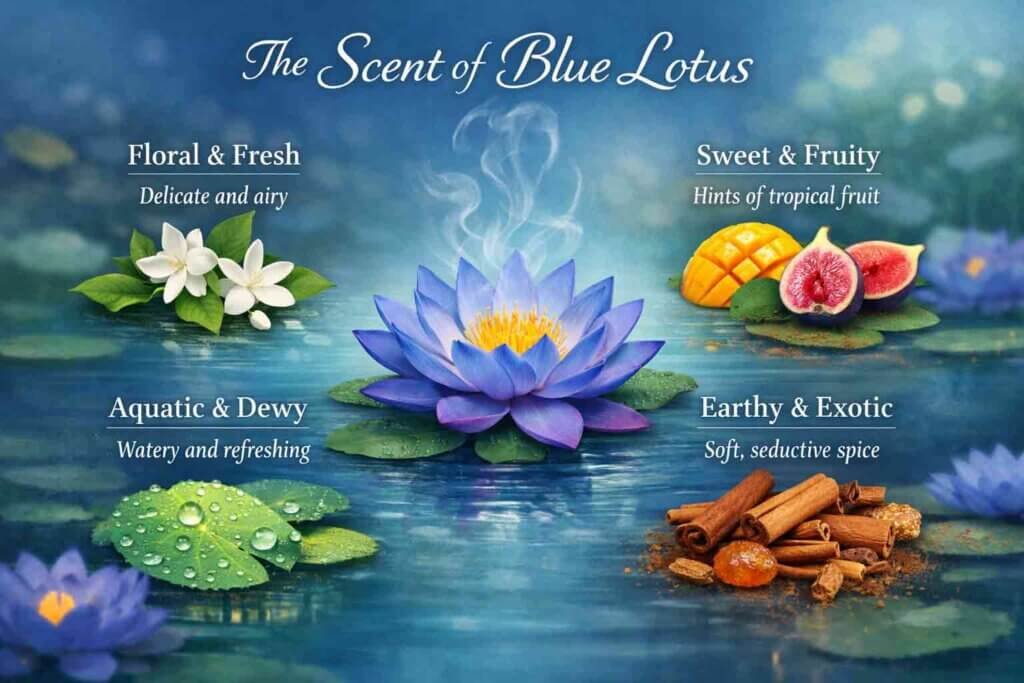
Blue lotus smells like a soft, watery floral with sweet, slightly earthy undertones and a faint hint of green freshness. It is often described as clean yet complex — somewhere between a white floral and an aquatic note, with a quiet warmth that lingers on the skin. Unlike the bold punch of jasmine or the heady richness of tuberose, blue lotus is subtle and meditative. It doesn’t shout. It whispers.
Many people describe the scent as having a dreamy, almost hypnotic quality — which makes perfect sense given that the blue lotus flower (Nymphaea caerulea) has been associated with altered states, spiritual ceremonies, and sacred ritual for thousands of years. There’s something in its aroma that feels ancient, as though inhaling it connects you to a time long past.
The Aromatic Profile: Breaking Down Blue Lotus Scent Notes
To truly understand the scent of blue lotus, it helps to think in terms of fragrance notes — top, middle, and base — the way a perfumer would.
The top notes of blue lotus are light and aquatic, carrying a fresh, slightly green quality that evokes still water and morning air. This is the first impression: clean, cool, and gently floral.
As the scent settles, the heart notes emerge — and this is where blue lotus really shines. The middle of the fragrance is warm, sweet, and gently spiced, with a soft powdery floral character. Some describe this middle phase as reminiscent of white tea or lotus blossom teas — not overpowering, just quietly present and deeply pleasant.
The base notes are where things get interesting. There’s a subtle earthiness, a faint woody quality, and a lingering warmth that keeps the scent grounded. Some noses even detect a very mild musky undertone, which adds sensuality without heaviness.
Together, these layers create a scent that is simultaneously serene and sensual, ancient and fresh.
How Blue Lotus Compares to Other Floral Scents
People often ask how blue lotus stacks up against other well-known florals, and it’s a fair question — especially if you’re trying to decide whether a product featuring blue lotus is right for you.
Compared to jasmine, blue lotus is far more restrained. Jasmine can be intoxicating and bold; blue lotus is meditative and soft. If jasmine is a grand operatic performance, blue lotus is an intimate acoustic set.
Compared to rose, blue lotus is less fruity and more aquatic. Rose carries warmth and sweetness with a slight tartness; blue lotus replaces that tartness with a clean, watery freshness.
Compared to ylang-ylang, which can be intensely sweet and almost overwhelming, blue lotus is far more approachable. It shares some of ylang-ylang’s exotic quality, but without the heaviness.
Perhaps the closest relative in the floral world is white lotus or pink lotus, but even then, blue lotus holds its own character. It tends to be slightly more watery and slightly less sweet than its pink counterpart, with a quality that feels more ethereal and less earthly.
Why Does Blue Lotus Have Such a Unique Smell?
The scent of blue lotus comes from its complex phytochemical makeup. The flower contains a range of aromatic compounds, including nuciferine, aporphine alkaloids, and various terpenes and flavonoids. These naturally occurring chemicals interact to produce the multilayered fragrance that has captivated humans for millennia.
The extraction method also dramatically affects the final scent. Blue lotus absolute — extracted through solvent extraction — tends to produce the richest, most complex version of the scent, capturing nuances that steam distillation may miss. Blue lotus essential oil, while beautiful in its own right, can sometimes be slightly lighter and more linear by comparison.
It’s also worth noting that blue lotus is sensitive to growing conditions. Flowers harvested from cleaner water environments with more sunlight tend to produce a more vibrant, layered fragrance. This is part of why truly high-quality blue lotus absolute is relatively rare and commands a premium price in the perfume and wellness industries.
The Ancient History of Blue Lotus and Its Sacred Scent
Understanding what blue lotus smells like is only half the story. The why it matters becomes even richer when you consider its history.
Blue lotus was considered sacred in ancient Egypt. It was depicted in hieroglyphics, featured in tomb paintings, woven into funerary garlands, and used in religious ceremonies. Ancient Egyptians believed the flower possessed divine properties, and its scent was associated with the gods, particularly the sun god Ra and the concept of creation and rebirth. The flower’s daily habit of closing at night and reopening at dawn made it a powerful symbol of the sun’s cycle.
Historical records and archaeological evidence suggest that blue lotus was used in ritual bathing, anointing oils, and ceremonial wine infusions — all partly because of its fragrance and partly because of its mild psychoactive properties. To experience the scent of blue lotus was, in ancient Egyptian culture, to be in the presence of the divine.
In ancient India and Southeast Asia, blue lotus held similarly reverent status. In Buddhist iconography, the blue lotus (known as utpala) symbolizes wisdom, knowledge, and the victory of the spirit over the senses. The fragrance was considered a spiritual gift, something that elevated the mind above ordinary experience.
What Blue Lotus Smells Like in Perfumery
In modern perfumery, blue lotus is a prized ingredient — both for its scent profile and its storied history. Perfumers use blue lotus absolute as a heart note that lends a refined aquatic-floral character to compositions. It blends beautifully with white musks, sandalwood, neroli, bergamot, and other aquatic notes.
You’ll find blue lotus featured in a range of luxury and niche fragrances, often in gender-neutral or feminine compositions. Its clean yet exotic character makes it versatile — equally at home in a fresh summer fragrance as it is in a deeper, more meditative evening scent.
When worn on skin, blue lotus has good longevity for a delicate floral — especially when it’s in the form of an absolute rather than a diluted essential oil. The warmth of body heat seems to activate its more subtle, sensual base notes, making it smell slightly different on each person who wears it.
Blue Lotus in Aromatherapy: How the Scent Affects the Mind
Beyond perfumery, blue lotus has a significant place in aromatherapy and holistic wellness. The scent is widely used to promote relaxation, reduce anxiety, and encourage a meditative state of mind. This isn’t simply anecdotal — the traditional use of blue lotus across ancient cultures consistently points to its mood-altering properties.
Inhaling blue lotus scent is said to calm the nervous system, quiet mental chatter, and open the mind to deeper states of awareness. Many meditation practitioners and yoga teachers incorporate blue lotus essential oil or absolute into their practices through diffusers, anointing oils, or ritual room sprays.
The scent is also associated with enhancing dream states — historically, blue lotus was used before sleep to encourage vivid, meaningful dreams. This dreamlike quality is baked right into the fragrance itself: its soft, floating, slightly otherworldly character has a way of loosening the grip of everyday mental noise.
Does Blue Lotus Smell the Same in Every Form?
This is an important question for anyone shopping for blue lotus products. The answer is no — the form of blue lotus makes a significant difference to how it smells.
Blue lotus absolute is the gold standard for scent. It is rich, complex, and true to the fresh flower. Because it captures a full spectrum of aromatic compounds, it delivers that multilayered floral-aquatic-earthy experience most completely.
Blue lotus essential oil is lighter and sometimes more one-dimensional, though it still carries the characteristic watery floral quality. It’s more accessible in price and widely used in aromatherapy blends.
Blue lotus tea smells far more subtle — primarily green and slightly sweet, with the floral note taking a back seat. The scent is gentler and more vegetal, though still pleasant and recognizable.
Blue lotus-infused skincare or candles will vary enormously depending on the quality of the ingredient and what it’s blended with. A well-made blue lotus candle can beautifully capture the flower’s aquatic warmth, while a poorly formulated one may smell vaguely synthetic or overly sweet.
How to Describe Blue Lotus Scent to Someone Who Has Never Smelled It
If you had to describe blue lotus to someone who had never encountered it, you might say something like this: Imagine standing at the edge of a still, sacred pond at dawn. The air is cool and slightly damp. There’s a warm sweetness drifting off the water — not sugary, but soft and floral. There’s something ancient about it, something that feels like it belongs in a temple or a ceremony. It’s clean but not sterile, exotic but not overwhelming. It smells like serenity has a scent.
That is blue lotus. Quiet, layered, hypnotic, and deeply beautiful.
Where to Experience Blue Lotus Scent
If you want to experience blue lotus for yourself, there are a few reliable ways to do it. Niche perfume houses often feature blue lotus in their collections, and many allow you to sample before committing to a full bottle. Exploring perfume discovery sets that include blue lotus compositions is a wonderful way to understand how it functions in a broader fragrance.
For a more direct experience, blue lotus absolute can be purchased from reputable essential oil suppliers and applied diluted to pulse points. Many aromatherapy shops and wellness boutiques also carry blue lotus in diffuser blends or incense form, making it easy to experience the scent in a home setting.
Conclusion
Blue lotus is more than just a pleasant fragrance — it is a sensory bridge between the ancient and the modern, between the sacred and the everyday. Its scent is soft and complex, aquatic and warm, sweet and earthy all at once. It carries within it thousands of years of human reverence, spiritual practice, and aesthetic appreciation.
Whether you encounter it in a luxury perfume, an aromatherapy blend, a wellness ritual, or a simple candle, blue lotus has a way of making its presence felt — gently, beautifully, and unforgettably. Once you’ve truly smelled it, you’ll understand why ancient civilizations considered it a gift from the divine. It doesn’t just smell good. It smells meaningful.
Frequently Asked Questions
Q1: Is blue lotus a strong or subtle scent?
Blue lotus is generally considered a subtle to moderate scent rather than a bold or overpowering one. It has a delicate, watery floral quality that is refined and understated. Unlike heavy florals such as ylang-ylang or tuberose, blue lotus whispers rather than shouts — making it ideal for people who prefer sophisticated, gentle fragrances that don’t overwhelm the senses. That said, a high-quality blue lotus absolute can have surprisingly good projection and longevity when worn on warm skin.
Q2: Does blue lotus smell similar to regular lotus or water lily?
Blue lotus shares some aromatic similarities with other lotus varieties and water lilies, but it has its own distinct character. It tends to be more aquatic and slightly less sweet than pink lotus, with a cooler, more ethereal quality. White water lily is perhaps the closest comparison — clean, fresh, and lightly floral — but blue lotus adds a subtle warmth and mild earthiness that sets it apart. If you’ve smelled lotus blossom tea, you have a rough sense of blue lotus, though the actual flower is considerably richer and more complex.
Q3: Can you wear blue lotus as a standalone perfume?
Absolutely. Blue lotus absolute or essential oil can be worn as a solo scent when properly diluted in a carrier oil such as jojoba or fractionated coconut oil. Many people find that its layered, meditative quality makes it a deeply personal and unique signature scent. Because it interacts with individual skin chemistry, it can smell slightly different on each person — which adds to its appeal as a standalone fragrance. For best results, apply it to pulse points like the wrists, neck, and inner elbows where body heat will help the scent bloom.
Q4: Why does blue lotus smell different in different products?
The variation in how blue lotus smells across different products comes down to extraction method, quality of the raw material, and formulation. A pure blue lotus absolute will smell far richer and more complex than a synthetic blue lotus fragrance oil. Additionally, what blue lotus is blended with — whether musks, woods, or other florals — will significantly shape the final scent experience. Always look for products that list Nymphaea caerulea absolute or essential oil as an ingredient rather than vague “blue lotus fragrance,” which may be entirely synthetic.
Q5: What mood or feeling does the scent of blue lotus evoke?
The scent of blue lotus is widely associated with calm, clarity, and spiritual elevation. Most people who smell it report feeling relaxed, centered, and gently uplifted — as though the mental noise of daily life has been turned down a notch. This is consistent with its thousands of years of use in meditation, ceremony, and sacred ritual across ancient Egypt, India, and Southeast Asia. In modern aromatherapy, it is frequently used to support stress relief, deeper meditation, and restful sleep. Its dreamy, aquatic character has a unique ability to quiet the mind while keeping the senses pleasantly engaged.