
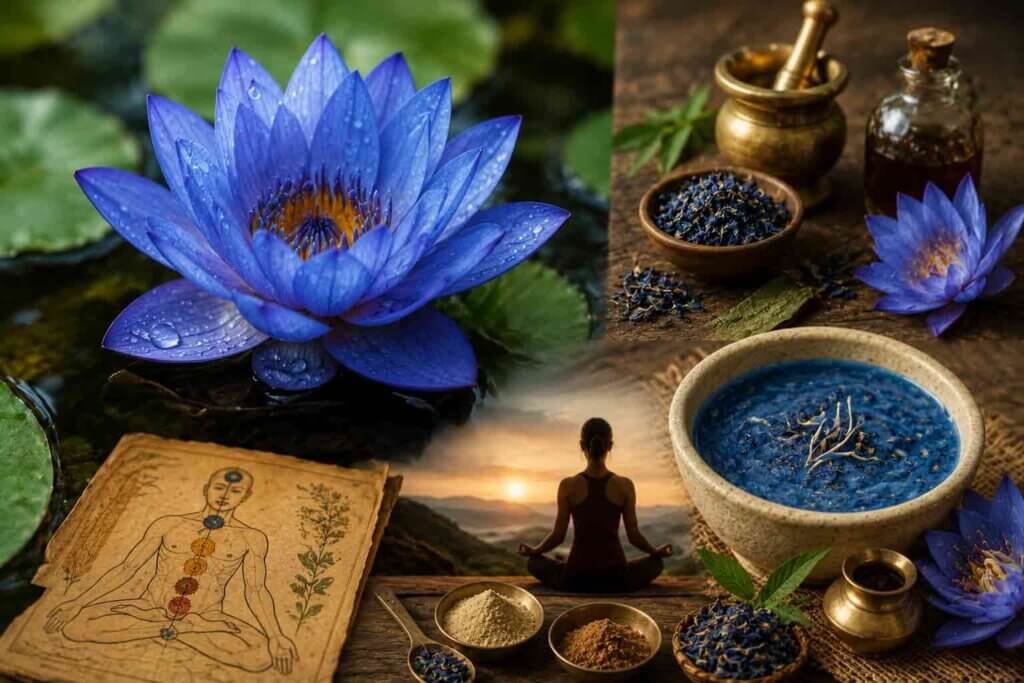
When most people hear the words “blue lotus,” their minds drift to ancient Egypt to painted tomb walls, golden sarcophagi, and pharaohs crowned with the indigo bloom. But here is the truth that history quietly overlooks: the blue lotus had already been revered, studied, and woven into a living medical tradition on the Indian subcontinent long before Egypt built its most famous pyramids. Ayurvedic medicine recognized the blue lotus not as a decorative symbol but as a therapeutic powerhouse, and that recognition shaped herbal healing in South Asia for thousands of years. Understanding that story changes the way we see this flower entirely.
What Is Blue Lotus and Why Does It Matter?
The plant known as blue lotus carries the botanical name Nymphaea caerulea. It is an aquatic flowering plant native to the Nile Valley and parts of East Africa, but it spread across trade and spiritual routes into South and Southeast Asia at a remarkably early period. In Ayurvedic texts, this flower appears under the Sanskrit name “Utpala” or sometimes “Nilotpala,” with “nila” meaning blue and “utpala” meaning lotus blossom. This distinction is important because Ayurveda has always been precise about which lotus species carries which medicinal property.
The flower blooms at sunrise and closes by midday, a rhythm that ancient physicians found deeply meaningful. Its fleeting daily bloom was interpreted as a metaphor for prana the life force that rises, sustains, and retreats and this symbolism was not merely poetic. It informed how and when the plant was harvested, prepared, and administered.
Ayurveda’s Relationship With Lotus Plants Across Millennia
The Ancient Texts and Their References
Ayurveda’s classical texts the Charaka Samhita, the Sushruta Samhita, and the Ashtanga Hridayam — collectively span compositions and compilations dating back over 2,500 years, with roots in oral traditions that are older still. All three of these foundational works make reference to lotus species in formulations addressing everything from fever management to reproductive health, from skin conditions to nervous system disorders.
The Charaka Samhita, which focuses primarily on internal medicine, references lotus flowers and their parts (petals, stamens, rhizomes, and seeds) as cooling agents, cardiac tonics, and substances that promote “Ojas” the vital essence in Ayurvedic physiology that governs immunity and overall vitality. The blue lotus specifically was considered particularly effective because of its tridoshic balancing properties, meaning it was thought to soothe imbalances in all three doshas Vata, Pitta, and Kapha rather than aggravating any one of them.
Rasayana and the Blue Lotus
One of Ayurveda’s most sophisticated branches is Rasayana, the science of rejuvenation and longevity. Rasayana formulations were designed not merely to treat disease but to enhance the quality of life, slow aging, and strengthen mental clarity. Blue lotus was included in Rasayana preparations, primarily because of its adaptogenic and nervine qualities. Ancient physicians observed that regular, properly prepared use of the flower seemed to calm anxious minds, improve sleep depth, and sharpen concentration. These are not vague spiritual claims they align remarkably well with what modern pharmacological research has begun to confirm about the plant’s active compounds.
The Active Compounds That Explain Ayurveda’s Confidence
Aporphine Alkaloids and Their Neurological Role
The blue lotus contains apomorphine and nuciferine, two alkaloids that have been the focus of increasing scientific attention. Apomorphine is a dopamine agonist, meaning it interacts with dopamine receptors in the brain. Nuciferine is believed to have antipsychotic and sedative properties. Together, these compounds help explain why Ayurvedic practitioners described the blue lotus as a plant that “clears the mind while calming the body” a combination that is genuinely difficult to achieve with most herbal medicines, which tend to either sedate or stimulate.
Ayurvedic physicians, working entirely without modern biochemistry, arrived at functionally accurate conclusions about this plant through centuries of careful observation and documentation. That is one of the most compelling arguments for taking traditional medical systems seriously in modern research contexts.
Antioxidant and Anti-inflammatory Flavonoids
The petals and stamens of Nymphaea caerulea are also rich in flavonoids, including quercetin and kaempferol. These compounds carry antioxidant and anti-inflammatory properties that support the cardiovascular system, protect liver cells, and reduce systemic inflammation. Ayurveda’s classification of the blue lotus as a “Hridya” (cardiac tonic) and a “Pittashamaka” (Pitta-reducing, or inflammation-cooling) herb fits precisely with this flavonoid profile.
Blue Lotus in Ayurvedic Treatment Protocols
Managing Anxiety and Nervous Exhaustion
One of the most consistent applications of blue lotus in classical Ayurveda was the management of what the tradition calls “Chittodvega” a state of mental agitation, worry, and nervous depletion that maps closely to what modern medicine calls generalized anxiety. The flower was prepared as a decoction, often combined with ashwagandha and brahmi, to create formulations that addressed both the acute symptoms of anxiety and its underlying constitutional drivers.
What made blue lotus particularly valued in these formulations was its ability to produce calm without dulling cognitive function. Many sedative herbs, even in Ayurveda, were considered too heavy for daytime use or for individuals who needed to maintain intellectual sharpness. Blue lotus offered a middle path.
Supporting Reproductive and Hormonal Health
The Sushruta Samhita references lotus preparations in the context of Vajeekarana Ayurveda’s branch dedicated to reproductive medicine and vitality. Blue lotus was considered an aphrodisiac in the classical sense, not simply as a stimulant of sexual desire but as a plant that nourishes the deeper tissues, particularly Shukra Dhatu (the reproductive tissue), and promotes overall hormonal equilibrium.
For women specifically, blue lotus was used to ease dysmenorrhea (painful menstruation) and to support recovery after childbirth. Its cooling, anti-inflammatory properties made it suitable for conditions associated with excess Pitta in the lower body — a traditional conceptual framework that aligns with modern understanding of prostaglandin-driven menstrual pain.
Skin and Complexion Treatments
Ayurvedic cosmetic medicine, known as Saundarya Vardhana, employed blue lotus extensively. The flower was incorporated into pastes and oils applied to the skin for conditions ranging from hyperpigmentation to inflammatory skin disorders. The logic was consistent with its internal use: the flavonoids that reduce internal oxidative stress work similarly on the skin’s surface, while the cooling energetics of the plant were thought to reduce redness and heat-related skin imbalances.
This tradition of topical blue lotus use has found a modern echo in the growing presence of the flower extract in luxury skincare formulations, though most contemporary brands advertising blue lotus have little awareness of how deep that tradition actually runs.
How Ayurveda’s Use Differs From Egypt’s Ritualistic Approach
Ritual Versus Clinical Application
Egypt’s relationship with blue lotus was profound, but it was predominantly ritualistic and spiritual. Wall paintings in tombs like that of Nebamun depict revelers inhaling the scent of blue lotus flowers at banquets, and researchers have theorized that the flower was steeped in wine for psychoactive purposes during religious ceremonies. The Egyptian relationship with the plant was real and significant, but it was largely sacramental.
Ayurveda’s engagement was different in character. The Indian tradition approached blue lotus as a clinician approaches a drug with dosage considerations, contraindications, preparation methods, combination protocols, and therapeutic targets. The Charaka Samhita specifies which part of the plant to use for which condition, which season is optimal for harvest, which preparation method preserves which properties, and which body types should use it with caution. This is not ritual. This is medicine.
The Concept of Gunas and Pharmacological Properties
Ayurveda operates through a sophisticated framework of “Gunas” (qualities) that describes every herb in terms of its taste (Rasa), potency (Virya), post-digestive effect (Vipaka), and special action (Prabhava). Blue lotus in this framework is classified as sweet and bitter in taste, cooling in potency, and sweet in post-digestive effect a profile that makes it deeply nourishing and appropriate for chronic use under guidance, unlike many more potent medicinal plants that must be used sparingly.
Egypt’s use of blue lotus, while sophisticated in its own right, never developed this systematic pharmacological language. The Indian tradition built a framework so detailed and internally consistent that it allowed physicians to predict interactions and effects with remarkable accuracy.
The Trade Routes That Carried Blue Lotus Knowledge
How the Plant Moved Between Civilizations
The ancient world was more interconnected than popular history suggests. Maritime trade routes between the Indian subcontinent, the Arabian Peninsula, and East Africa were established as early as the third millennium BCE. It is entirely plausible and supported by some archaeobotanical evidence that Nymphaea caerulea moved through these trade networks in both directions, and that knowledge about its properties traveled with it.
Some historians of medicine argue that Egypt may have learned aspects of its lotus use from Indian traders and physicians, rather than the other way around. While this remains a matter of academic debate, what is not debatable is that Ayurvedic documentation of blue lotus use is extraordinarily detailed in ways that suggest a tradition developed over a very long time with rigorous clinical observation.
Modern Revival and Validation of Ayurvedic Blue Lotus Knowledge
What Contemporary Research Is Confirming
The last two decades have seen a meaningful uptick in scientific research on Nymphaea caerulea and its constituents. Studies have examined nuciferine’s receptor-binding profile, apomorphine’s dopaminergic activity, and the antioxidant capacity of the flower’s flavonoid content. The findings are broadly consistent with what Ayurveda claimed for centuries anxiolytic effects, mild psychoactive properties at higher doses, anti-inflammatory activity, and cardiovascular support.
This convergence of traditional wisdom and modern science is not a coincidence. It is evidence that empirical observation, conducted carefully over generations, can arrive at pharmacologically valid conclusions even without the tools of contemporary biochemistry.
Blue Lotus in Integrative Medicine Today
Practitioners of integrative and functional medicine are beginning to incorporate blue lotus into protocols for stress management, sleep quality improvement, and cognitive support. Formulations inspired by Ayurvedic Rasayana principles combining blue lotus with adaptogens like ashwagandha and nervines like brahmi are appearing in the wellness market with increasing frequency.
The challenge, as always in the herbal medicine space, is quality and standardization. Traditional Ayurvedic preparations used fresh or carefully dried whole plant material, processed according to specific protocols. Many commercial products cannot claim the same standards, which is why working with knowledgeable practitioners and sourcing high-quality preparations remains essential.
How to Approach Blue Lotus From an Ayurvedic Perspective Today
Finding Qualified Guidance
Anyone interested in using blue lotus therapeutically should approach it within the framework it was designed for. An Ayurvedic practitioner can assess your individual constitution (Prakriti) and current imbalance (Vikriti) to determine whether blue lotus is appropriate, in what form, at what dose, and in combination with which other herbs. Self-prescribing based on general information, while tempting, misses the individualized intelligence that makes Ayurveda powerful.
Forms and Preparations
Traditional preparations include decoctions (Kwatha), medicated ghee (Ghrita), herbal oils (Taila), and powder formulations (Churna). Each preparation extracts and preserves different aspects of the plant’s therapeutic profile. Decoctions are more appropriate for acute applications, while medicated ghees and oils are suited for Rasayana use long-term, constitutional nourishment.
In contemporary contexts, blue lotus is also available as a dried tea herb, tincture, and extract powder, but the alignment of these modern formats with traditional preparation wisdom varies considerably.
Conclusion
The blue lotus deserves to be understood in its fullest context. Egypt gave us breathtaking art celebrating this flower, but Ayurveda gave us a complete medical science built around it. The Sanskrit texts that described blue lotus as a tridoshic nervine, a Rasayana herb, a cardiac tonic, and a reproductive supportive were not writing mythology they were recording the accumulated clinical intelligence of generations of careful physicians.
As modern science continues to validate what those physicians observed, it is worth pausing to acknowledge how extraordinary that is. A medical tradition that flourished thousands of years ago, without microscopes or mass spectrometers, identified the therapeutic properties of a complex plant with enough accuracy that contemporary pharmacology is largely confirming rather than correcting it. That is not coincidence. That is the result of a rigorous, systematic, and profoundly human commitment to understanding the healing power of the natural world.
Blue lotus was not discovered by Egypt. It was systematized by India. And the tradition that built that system of knowledge remains, today, one of the most sophisticated and underappreciated medical frameworks on earth.
Frequently Asked Questions
Q1: What is blue lotus called in Ayurveda?
In Ayurvedic texts, blue lotus (Nymphaea caerulea) is referred to as “Nilotpala” or “Utpala,” where “nila” means blue and “utpala” means lotus blossom. It is classified as a tridoshic herb, meaning it balances all three doshas.
Q2: Did Ayurveda use blue lotus before ancient Egypt?
Ayurvedic oral traditions and early texts predate Egypt’s most documented use of blue lotus. While Egypt used it ritually, Ayurveda developed a detailed clinical framework around it — with dosages, preparations, and therapeutic targets suggesting a much older and more systematic engagement with the plant.
Q3: What conditions does blue lotus treat in Ayurveda?
Classical Ayurveda used blue lotus primarily for anxiety, nervous exhaustion, reproductive health, skin disorders, and as a heart tonic. It was also a key ingredient in Rasayana formulations aimed at longevity and mental clarity.
Q4: Is blue lotus safe to use daily? Under proper Ayurvedic guidance, blue lotus is generally considered safe for regular use due to its cooling, nourishing, and tridoshic nature. However, individual constitution and current health conditions must be assessed by a qualified practitioner before use.
Q5: What makes blue lotus different from other lotus species in Ayurveda?
Ayurveda is precise about lotus varieties. Blue lotus (Nilotpala) is specifically valued for its nervine, cooling, and mildly psychoactive properties, whereas the white lotus and pink lotus are used for different therapeutic purposes. Each species carries a distinct pharmacological profile in the classical texts.