
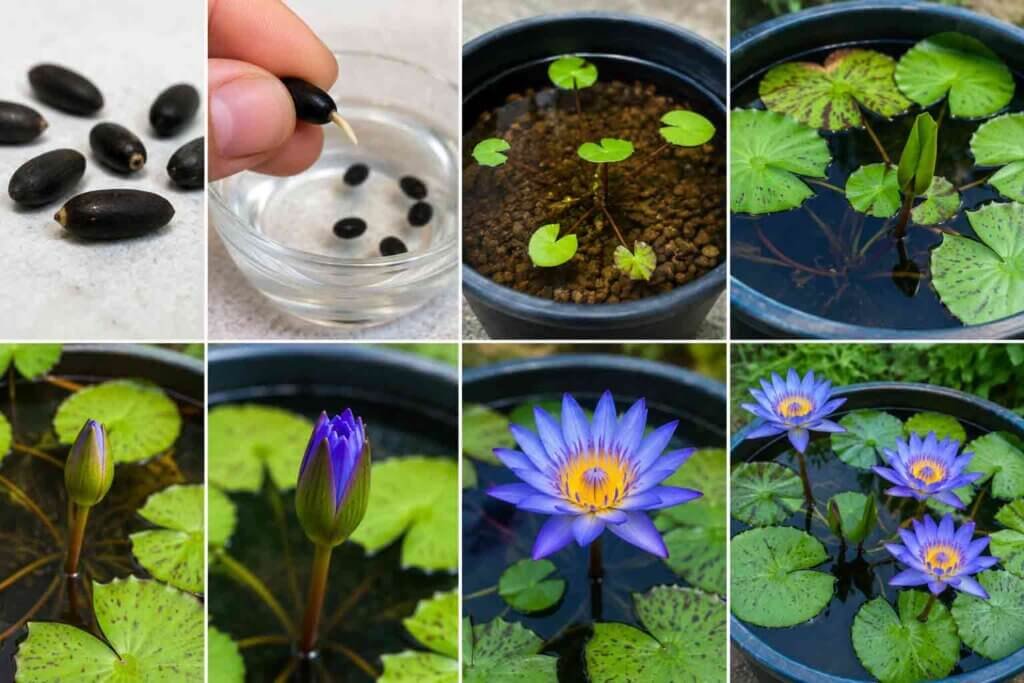
Most people first encounter blue lotus in a photograph — a pale violet star floating above still water with a golden center, petals like fine porcelain, the whole thing looking slightly too perfect to be real. Then they realize it grows from a seed the size of a poppy grain and blooms in a backyard pond, and they want one immediately.
What takes them by surprise is how patient the plant demands you be. Blue lotus (Nymphaea caerulea) will not rush. From the moment you drop those tiny seeds into warm water to the morning you see the first bud rise above the surface, you are looking at a six-to-twelve-month commitment — sometimes longer. That is not a deterrent. That is the nature of growing something ancient.
This guide covers the full journey: what the plant actually looks like at each stage, what conditions it needs, how to move it from germination jar to pond, what goes wrong (and why), and what you can realistically expect on the day the first bloom finally opens.
What Blue Lotus Actually Is — and What It Isn’t
Before planting a single seed, it helps to be clear on what Nymphaea caerulea is and what it is not, because the naming confusion around this plant is genuine and has caused a lot of gardeners to end up with the wrong species.
Blue lotus is a tropical water lily — a member of the Nymphaeaceae family, not the Nelumbo genus. Nelumbo species are the “true lotuses,” the ones with tall seed pods that stand above the water on thick green stems. Nymphaea caerulea grows differently: its flowers and leaves emerge from rhizomes buried in mud, floating at or just above the water’s surface. The seed pods, after pollination, sink back under water to develop.
The plant is native to northern and central Africa, particularly along the Nile River, where it thrived in shallow, calm waterways. It was revered in ancient Egyptian culture as a symbol of creation and rebirth — partly because of its behavior: each morning it opens with the sun, and by early afternoon it closes again, as if following the sky’s arc across the day.
What you are working with, botanically, is a rhizomatous aquatic perennial. The rhizome anchors in muddy substrate and spreads horizontally as the plant matures, gradually extending its footprint across the water’s surface. Everything visible — leaves, flower stalks, blooms — rises from that buried root system.
What the Plant Looks Like at Each Stage
Understanding what you are looking at through each phase prevents the most common mistake: discarding seedlings that look wrong because they do not yet look like the plant on the seed packet.
The Seed
Blue lotus seeds are small — between one and two millimeters. They look like tiny pale grains with a slightly waxy coating. Unlike the hard, dark seeds of true lotus (Nelumbo), Nymphaea seeds are relatively soft and permeable. Fresh seed is crucial; old or poorly stored seed has dramatically reduced viability.
Germination: Days 5–21
When seeds are placed in warm, shallow water with adequate light, the first sign of life is a tiny root thread — almost invisible — followed within a few days by a thread-like shoot. These early seedlings look like fine grass rather than any recognizable water plant. A common mistake is assuming nothing is happening when in fact germination has begun.
Germination typically occurs within 7 to 14 days under optimal conditions, though it can stretch to three weeks depending on water temperature and seed quality. The key variables are warmth (water temperature between 20–30°C / 68–86°F) and light. Too cold and germination stalls entirely.
Early Seedling Stage: Weeks 2–6
Once the shoot elongates, the first floating leaf appears — a tiny, coin-shaped pad that lies flat on the water surface. At this stage the whole plant might span two centimeters across. The leaf is translucent, pale green, and fragile. A single splash or strong surface disturbance can damage it. The seedling is feeding off stored energy from the seed; it has not yet established a root system capable of drawing nutrients from soil.
This is the phase where patience becomes a practical requirement. The seedling will produce several small leaves before it is ready for substrate.
Vegetative Growth: Weeks 6–16
Once transplanted into aquatic soil, the plant enters its main vegetative phase. New leaves emerge progressively larger, and the rhizome begins expanding laterally. Mature floating leaves are dark green, smooth, and leathery — measuring 20 to 40 centimeters across, with a distinctive notch where the stem attaches. The leaf edges are slightly wavy and the surface is hydrophobic, causing water to bead and roll off. Underneath, the leaf is reddish or maroon in younger plants.
At this stage the plant starts to claim visible space. A mature specimen can spread its leaves across roughly one meter of water surface. For a small container pond, that coverage is substantial — and it matters, because leaf coverage shades the water, slows algae growth, and keeps the water temperature stable.
Bud Formation and First Bloom: Months 3–12
The first blue lotus flower bud appears as a tight green cone rising on a separate stalk from the rhizome. It lifts above the water surface — typically 15 to 20 centimeters — before opening. Once it does, the transformation is striking: 14 to 20 pointed petals unfurl into a flat star shape, pale blue at the tips, deepening toward the golden-yellow center. More than 100 delicate stamens surround the central structure.
Each bloom lasts three to four days before wilting. The flower opens in the morning with the sun and closes by early afternoon. This daily cycle repeats for the duration of each individual bloom. After the flower fades, the stalk bends and pulls the developing seed pod back under water to mature.
Once a plant is established and blooming, it can produce flowers across the entire warm season — and in ideal conditions, it may repeat bloom cycles three to four times per year.
Setting Up the Right Environment Before You Start
The most common reason blue lotus fails is not neglect — it is setup. The plant has specific environmental requirements, and trying to adapt around them once the plant is in the water is much harder than getting conditions right from the beginning.
Water Depth and Container
For germination, water depth of 5 to 10 centimeters is ideal. The seeds need to sit in warm, shallow water where light can penetrate. Deep water is cold water at the seed level, and cold water stops germination.
For a growing container or small pond, a minimum depth of 30 centimeters is standard for established plants, with the rhizome planted in substrate at the bottom and the water level maintained above it. The plant does not want to be in a fast-moving water feature. Still or very slow-moving water mimics its natural habitat.
If you are growing in a container rather than an in-ground pond, choose something large enough to allow for spread. A half-barrel water garden or a container at least 60 centimeters in diameter gives the rhizome room to expand without immediately hitting the walls. Smaller vessels can work for the first season, but you will likely need to repot.
Water Quality and Temperature
Blue lotus is sensitive to chlorinated tap water, particularly at the seedling stage. Rainwater, filtered water, or water that has been left to off-gas for 24 to 48 hours is preferable for germination setups. For an established outdoor pond, the plant generally adapts to local water quality once it has a healthy root system.
Water temperature is non-negotiable: 20 to 30°C (68–86°F) for active growth, with the sweet spot between 24 and 27°C. Below 18°C, growth slows dramatically. Below 15°C, the plant stops growing and begins to decline. In climates where water temperature drops in winter, the plant requires either bringing inside or overwintering with reduced water levels while it goes semi-dormant.
Sunlight
A minimum of six hours of direct sunlight daily is required for healthy growth and flowering. Eight hours is better. Less than six hours produces weak, leggy plants with pale leaves and no flowers. This is not a shade-tolerant plant.
For indoor setups — a heated aquarium or large container on a sunny windowsill — supplemental grow lighting is often necessary to meet this threshold in temperate climates.
Soil and Substrate
Nymphaea caerulea does not grow in the gravel or inert substrates used for aquarium plants. It needs heavy loam — ideally a clay-rich soil that stays dense under water and holds nutrients near the roots. Specialized aquatic planting mix works well. Lightweight potting mix is not suitable; it floats, disperses, and provides almost no nutrition.
Plant the rhizome in heavy soil in a wide, shallow planting basket or pot, then lower the basket into the pond so the rhizome is at the correct depth. Do not bury the growing tip of the rhizome — it should remain just at or slightly below the soil surface, with the leaf stalks able to reach upward freely.
From Seed to Pond: The Step-by-Step Process
Step 1 — Prepare the Germination Setup
Fill a small, clear glass or container with 5 to 8 centimeters of warm water. Use rainwater or off-gassed tap water. Place the container where it will receive bright light for most of the day — a south-facing windowsill or under a grow light in cooler months.
If you are in a cooler climate, a seedling heat mat under the container makes a significant difference. Maintaining water temperature consistently at 28–32°C during germination produces faster, more reliable sprouting and is worth the investment.
Step 2 — Sow the Seeds
Drop the seeds directly into the water. Do not bury them in soil at this stage. Blue lotus seeds germinate in water, not in substrate. Space them so they are not crowded — a few seeds per small container. Some growers prefer individual vials for each seed, which makes handling seedlings easier at transplant time.
Keep the water topped up. Evaporation in a small container can lower the water level quickly, and exposed seeds dry out and die.
Step 3 — Wait and Watch
Germination begins within 7 to 14 days under good conditions. The first sign is a thin white root thread, followed by a shoot. Once the shoot emerges and produces its first floating leaf, the seedling is ready to begin transitioning to substrate — usually after it has developed two to three true leaves.
Do not rush this transition. Moving a seedling with only one leaf often damages the root thread and sets the plant back by weeks.
Step 4 — Transplant to Substrate
Fill a small planting basket or pot (10 to 15 centimeters) with damp heavy loam or aquatic soil. Make a shallow depression in the center. Carefully lift the seedling — handling the root, not the leaf — and position it so the root sits in the depression and the leaf floats free above the soil surface.
Lower the container into a larger vessel of warm water so the plant is submerged to the same depth it was growing at before. Keep it in a warm, sunny location. Feed with diluted aquatic fertilizer once per month once the plant is clearly establishing new leaves.
Step 5 — Scale Up as the Plant Grows
As the plant produces larger leaves and the rhizome expands, move it progressively to larger containers. A seedling that starts in a 15-centimeter pot will eventually need a 40-to-60-centimeter planting basket at maturity. Roots that are restricted in a small pot produce fewer, smaller leaves and are less likely to flower.
Once the plant is established and water temperatures are consistently warm, move it to its permanent home — whether a container pond, half-barrel feature, or in-ground garden pond.
Step 6 — Introduce to the Outdoor Pond
If you started seeds indoors in spring, the plant may be ready for outdoor conditions by midsummer, once nighttime air temperatures have stabilized and water temperature in the pond is reliably above 20°C.
Acclimate the plant gradually if there is a significant temperature difference between indoors and outdoors. A few days near the pond surface before fully submerging gives the plant time to adjust.
What Goes Wrong and How to Fix It
Seeds Do Not Germinate
The most common cause is cold water. If your germination container is sitting in a room below 20°C, germination may not occur at all. Move it somewhere warmer, or use a heat mat. Old seed is the second most common cause — freshness matters, and reputable seed suppliers make a difference.
Seedlings Appear, Then Die
This usually happens in the early transplant phase. Root disturbance during transplanting, moving a seedling before it has enough leaves to sustain itself, or a sudden drop in water temperature can all cause collapse. Handle early seedlings carefully and avoid transplanting until two to three true leaves have developed.
Leaves Are Pale or Yellow
Pale leaves in an established plant indicate either insufficient sunlight or nutrient deficiency. Move the plant to a sunnier position first. If sunlight is adequate, apply an aquatic plant fertilizer — slow-release tablets pushed into the substrate near the roots are effective and will not cloud the water.
No Flowers After a Full Season
This is the most common frustration. Blue lotus will not bloom without adequate sun, warm water, and an established root system. A plant that spent its first season getting established in a small container may simply not be mature enough to flower. Patience, and moving to a larger container the following spring, usually resolves this. Container size restriction is frequently the culprit — the rhizome needs room to spread before the plant shifts energy toward reproduction.
Pests
The two most common pests on Nymphaea caerulea are aphids and water lily leaf beetles. Aphids cluster on the undersides of leaves and can be dislodged with a strong jet of water. Leaf beetles chew holes in the pads. Manual removal is usually sufficient for a small home pond; if the infestation is heavy, aquatic-safe insecticide is an option, but be careful about anything that might affect pond fish or other aquatic life.
Caring for the Plant Once It’s Blooming
An established, flowering blue lotus is lower maintenance than the seedling phase suggests. The main care tasks are:
Deadheading and pruning. Remove spent flowers and yellowing leaves at the stem base. This keeps the water cleaner, prevents fungal issues, and redirects the plant’s energy toward new growth and further blooms.
Fertilizing. Monthly application of slow-release aquatic fertilizer tablets during the growing season maintains leaf color and encourages flowering. Stop fertilizing as temperatures begin to cool in autumn.
Water level. Maintain consistent water depth. Dramatic drops in water level expose the rhizome, stress the plant, and can set it back significantly.
Winter management. Blue lotus is a tropical plant and does not survive hard frosts. In climates with cold winters, the plant needs to be brought indoors before temperatures drop. Move the planting basket to an indoor aquarium or heated greenhouse, reduce watering, and allow the plant to go semi-dormant. Resume normal care and fertilization in spring when nighttime temperatures warm again.
The First Bloom: What to Expect
When the first bud appears — a tight green cone lifting on its own stalk, slightly above the leaf canopy — give it two to four days to develop before it opens. On the morning it chooses to bloom, the petals unfurl slowly over the course of an hour or two. By mid-morning you have the full flower: pale blue-violet petals spreading flat in a star shape, a dense golden center, and a scent that is light and sweet — floral with an earthy undertone.
The bloom lasts three to four days before the petals drop and the stalk draws the developing seed pod back under water.
If conditions are right, the plant will produce another bud within a few weeks. A mature, well-established plant blooming at peak season can carry multiple open flowers simultaneously.
That first bloom is the payoff for months of patience — and the signal that the plant has settled in and intends to stay.
Quick-Reference Care Summary
| Factor | Requirement |
|---|---|
| Water temperature | 20–30°C (68–86°F); ideal 24–27°C |
| Water depth (established plant) | 30–60 cm |
| Sunlight | Minimum 6 hours direct sun daily |
| Substrate | Heavy loam or aquatic planting mix |
| Fertilizer | Monthly aquatic fertilizer tablets during growing season |
| Germination time | 7–21 days |
| Time to first bloom | 6–12 months from seed |
| Bloom cycle | Flowers open morning, close by early afternoon; each bloom lasts 3–4 days |
| Spread at maturity | Up to 1 meter across water surface |
| Winter care | Bring indoors if temperatures drop below 15°C |
Final Thought
Blue lotus rewards growers who understand what they are actually working with: a tropical aquatic perennial with deep evolutionary roots in warm, slow water, not a plant that performs on demand. Get the temperature right, give it full sun, use proper substrate, and give the rhizome room to spread — and the plant will bloom on its own schedule, which turns out to be more satisfying than anything fast.
The morning that first flower opens, you will understand why ancient Egyptians built temples around it.
Frequently Asked Questions
Q: How long does it take for blue lotus to bloom from seed?
Most growers see their first bloom between 6 and 12 months from seed. The exact timeline depends on water temperature, sunlight, and container size. A plant that spends its first season in a small pot is unlikely to flower until it has been moved to a larger growing space the following spring.
Q: Can I grow blue lotus in a container instead of a pond?
Yes. A half-barrel water garden or any container at least 60 cm in diameter works well. The key requirements are the same as for a pond: still or slow-moving water, heavy loam substrate, full sun for at least 6 hours a day, and water temperature consistently above 20°C.
Q: Why aren’t my blue lotus seeds germinating?
Cold water is the most common cause. Blue lotus seeds need water temperatures between 20–30°C to sprout reliably. If your setup is cooler than that, germination stalls or fails entirely. A seedling heat mat under the germination container solves the problem in most cases. Old or poorly stored seed is the second most common cause.
Q: Does blue lotus come back every year?
It is a perennial, but it is tropical — it does not survive hard frosts. In warm climates (USDA zones 10–12), it will return each season without intervention. In cooler climates, the planting basket needs to be brought indoors before temperatures drop below 15°C, kept in a warm, reduced-water environment over winter, and moved back outside in spring.
Q: How do I know when my blue lotus is about to bloom?
Watch for a tight green cone rising on its own stem above the leaf canopy — separate from the leaf stalks. That bud will take two to four days to develop before opening. On bloom day, the petals begin unfurling in the morning and the flower is fully open by mid-morning. Each bloom lasts three to four days before the stalk draws the spent flower back under the water.