TL;DR / Key Takeaways
-
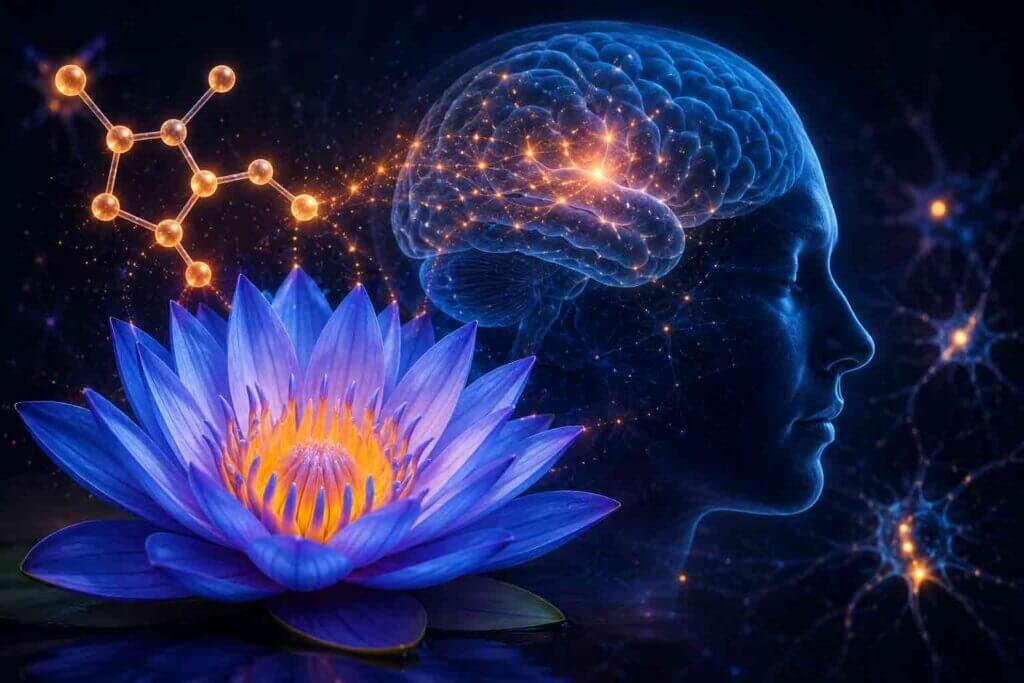
Blue lotus (Nymphaea caerulea) contains two primary alkaloids — apomorphine and nuciferine — that directly interact with dopamine receptors in the brain.
-
Apomorphine is a dopamine agonist: it activates dopamine receptors, potentially elevating mood, motivation, and pleasure.
-
Nuciferine is a dopamine antagonist: it blocks certain receptors, paradoxically keeping more dopamine available in the synapse.
-
Both compounds also interact with serotonin receptors and may inhibit MAO, the enzyme that breaks down mood-regulating neurotransmitters.
-
Human clinical trials on blue lotus are still limited; most evidence is from animal studies, in vitro research, and historical use.
-
Blue lotus has been used ritualistically for over 3,000 years; its pharmacology is now beginning to explain why.
A Sacred Flower With a Chemistry Lab Inside
When archaeologists opened Tutankhamun’s tomb in 1922, the pharaoh’s body was covered in blueish-white petals. Not roses. Not lilies in the conventional sense. Blue lotus — Nymphaea caerulea — the most sacred plant of ancient Egyptian civilization.
At the time, no one could explain the chemistry. The Egyptians didn’t know about dopamine receptors or alkaloid pharmacology. What they knew was the effect: a gentle shift in consciousness, a loosening of tension, a drift toward something more expansive.
It took until 1822 for scientists to confirm that Nymphaea caerulea contains psychoactive compounds. Nearly two centuries later, researchers are still mapping exactly how those compounds work — and the dopamine connection is emerging as one of the most scientifically compelling parts of the story.
What Is Blue Lotus, Exactly?
Definition: Blue lotus (Nymphaea caerulea), also called the Egyptian blue water lily or sacred blue lily of the Nile, is a perennial aquatic plant native to East Africa that was central to ancient Egyptian religious, spiritual, and medical practice.
Botanically, it belongs to the family Nymphaeaceae and is distinct from the Indian sacred lotus (Nelumbo nucifera), though both plants share overlapping alkaloid profiles that have drawn scientific attention.
The flower’s characteristic behavior — opening during daylight and closing at night — made it a symbol of the sun god Ra and the cyclical nature of life and death. Pharaohs and priests were believed to have exclusive access to its “special gift,” according to ethnobotanical records. The plant was infused into wine, brewed as tea, and used in funerary rites to ease the deceased’s passage to the afterlife.
What the Egyptians were consuming, in modern pharmacological terms, was a dose of apomorphine and nuciferine — two alkaloids that sit at the center of the blue lotus–dopamine story.
The Two Alkaloids That Drive Everything
Apomorphine: The Dopamine Agonist
Apomorphine is, despite its name, not derived from morphine and is not an opioid. It is classified as a non-selective dopamine agonist — a compound that mimics dopamine by binding directly to dopamine receptors and triggering the same downstream effects the neurotransmitter itself would produce.
This distinction matters. Apomorphine has been used in clinical medicine since the late 1800s, originally for insomnia and depression. Today, it is an FDA-approved treatment for Parkinson’s disease, marketed under the brand name Apokyn, where it is administered by subcutaneous injection to manage “off episodes” — sudden lapses in motor function caused by dopamine depletion.
A 2025 meta-analysis published in BMC Neurology, examining 20 clinical studies and 1,262 Parkinson’s patients, confirmed that apomorphine treatment significantly improved motor function compared to placebo (Li et al., 2025, DOI: 10.1186/s12883-025-04516-7).
The dose found in blue lotus flower extract is dramatically lower than therapeutic Parkinson’s dosages — a 2017 study published in the Journal of Forensic Sciences (Poklis et al.) found apomorphine in analyzed N. caerulea samples at concentrations of between 1 ng/mL and 130 ng/mL. Whether these concentrations are pharmacologically meaningful in humans when consumed as tea or tincture remains an open question.
What researchers do agree on: apomorphine stimulates D1 and D2 dopamine receptors, which are distributed throughout the brain’s reward circuitry, prefrontal cortex (linked to focus and decision-making), and limbic system (linked to emotion and motivation). This receptor activation is the plausible mechanism behind the mood-elevating and euphoric effects users commonly report.
Nuciferine: The Dopamine Antagonist That Isn’t What It Sounds Like
Nuciferine is the more abundant of the two alkaloids in blue lotus and also the more pharmacologically complex. In 2016, a study published in PLOS One (Farrell et al.) mapped nuciferine’s complete receptor profile, finding it acts as:
- An antagonist at 5-HT2A, 5-HT2C, and 5-HT2B serotonin receptors
- A partial agonist at D2 and D5 dopamine receptors
- A compound with antipsychotic receptor characteristics similar to clozapine, one of the most effective antipsychotic medications available
The dopamine antagonist classification sounds counterintuitive for a mood-enhancing plant. But here is the mechanism that makes it interesting: by blocking certain dopamine receptors, nuciferine may cause dopamine to remain longer in the synaptic cleft rather than being reabsorbed. A 1978 study found that nuciferine’s receptor blockade produces a relaxing, sedative effect consistent with this mechanism. The result is a modulation rather than a raw stimulation of the dopaminergic system — which may explain why blue lotus produces a calmer, more controlled shift in mood rather than a sharp stimulatory spike.
A 2025 review published in PMC (NCBI) examining the neuroprotective properties of lotus alkaloids found that total alkaloids from lotus leaves can increase GABA levels in the brain, promote GABA-A receptor activity, and elevate both serotonin and dopamine levels — effects consistent with the regulation of sleep-wake cycles and anxiety reduction.
The Dopamine–Mood Connection: Why This Matters
Dopamine is often reduced in popular science to the “pleasure chemical,” but its actual role is considerably more nuanced. It governs motivation, anticipatory reward, focus, emotional regulation, and movement. Chronic low dopamine function is associated with depression, anhedonia (the inability to experience pleasure), ADHD, and conditions like Parkinson’s disease.
Both apomorphine and nuciferine influence the dopaminergic system in complementary, if mechanistically opposite, ways:
| Compound | Dopamine Action | Net Effect |
|---|---|---|
| Apomorphine | Agonist: activates D1/D2 receptors | Increases dopaminergic signaling |
| Nuciferine | Antagonist: blocks select receptors | Modulates signaling; may increase synaptic dopamine |
| Both combined | Dual modulation of the system | Balanced mood elevation + relaxation |
Research published in Phytomedicine suggests that blue lotus may also inhibit monoamine oxidase (MAO), the enzyme responsible for breaking down both serotonin and dopamine in the brain. If confirmed in human trials, this would be significant: MAO inhibition is the same mechanism used by a class of antidepressants called MAOIs, which extend the availability of mood-regulating neurotransmitters.
Early research has proposed that apomorphine holds potential in the treatment of depression, anxiety, insomnia, and schizophrenia — conditions that all involve disrupted dopaminergic or serotonergic signaling. Nuciferine has separately shown effectiveness in treating alcohol use disorder in animal studies, a condition closely tied to dysregulated dopamine reward pathways.
What the Ancient Egyptians Understood (Without Knowing Why)
The historical record on blue lotus is unusually well-documented for a pre-scientific plant medicine. Depictions of Nymphaea caerulea appear on Egyptian papyri and tomb walls dating to the 14th century BCE. Frescoes from the Tomb of Nebamun, now housed in the British Museum, show ritualistic funeral dances where women are garlanded with blue lotus petals while offering vases, suggesting the plant played a central role in transition rites.
The plant was offered to the gods Ra and Nefertem in temple ceremonies. It appeared in the Egyptian Book of the Dead. Alongside mandrake fruit and poppy flowers, blue lotus was believed to be part of preparations used to induce ecstatic or visionary states in priestly contexts — with access restricted to the elite and the dead.
According to UC Berkeley researcher Liam McEvoy, who has studied the cultural significance of the flower through Egyptological and chemical analysis, what ancient Egyptians consumed may have been chemically different from products sold online today. His research distinguishes between the authentic Nymphaea caerulea and related Nymphaea species now commercially distributed — an important nuance for anyone researching this plant’s effects.
What the Egyptians did not have was the vocabulary to describe dopamine receptor agonism. What they clearly possessed was a reliable method for producing the effects it creates.
Blue Lotus and the Brain: A Broader Neurotransmitter Picture
The blue lotus–dopamine connection is the most researched component of the plant’s pharmacology, but it operates within a wider neurochemical context.
GABA System: Research on related lotus species shows that lotus alkaloids can promote GABA-A receptor activity, producing anxiolytic and sedative effects. This may account for the characteristic calm that users describe — not a stimulant-like energizing, but a loosening of nervous tension.
Serotonin System: Nuciferine acts as a partial agonist at 5-HT1A receptors and an antagonist at 5-HT2A receptors — the same receptor profile targeted by several antidepressants and some antipsychotics. Studies on related lotus species have shown increased serotonin and 5-HIAA concentrations following alkaloid administration in animal models.
Flavonoids: Blue lotus is also rich in flavonols including quercetin, kaempferol, and myricetin, which have demonstrated antioxidant, antimutagenic, and mild sedative properties in research. These compounds add a secondary layer to the plant’s overall neurological effect profile.
The combined result of these interactions — dopaminergic modulation, GABAergic enhancement, serotonergic activity, and flavonoid support — is what researchers describe as a “multifaceted mechanism,” a key finding from a 2025 PMC review on lotus alkaloid neuroprotection. Multi-target botanical compounds may confer broader neurobiological benefits than single-mechanism interventions, which explains why the traditional applications of blue lotus across sleep, anxiety, mood, and cognition are all plausible rather than contradictory.
How People Use Blue Lotus Today
Blue lotus is currently legal in most countries, though it is prohibited for military personnel in the United States (per the Office of Dietary Supplement Programs, updated 2024) and classified as a controlled substance in Russia and a few other jurisdictions.
Common consumption methods include:
- Tea: Dried flowers steeped in hot water; one of the most widely used methods, producing milder effects
- Tincture: Alcohol extract of the flower; more concentrated
- Wine infusion: The traditional Egyptian method, mimicking ancient preparations
- Smoke or vapor: Faster onset (within minutes); effects typically last a few hours
Users commonly report mild euphoria, reduced anxiety, a gentle elevation in mood, deeper sleep, and more vivid dreams. At higher doses, mild perceptual alterations and a dream-like state have been described.
One important practical note: some products marketed as blue lotus have been found to contain synthetic cannabinoids rather than authentic Nymphaea caerulea, according to toxicology reports. Concentration and compound ratios vary significantly between products, and no standardized dosing guidelines exist.
What the Research Cannot Yet Confirm
Intellectual honesty requires being clear about the limits of current evidence.
Most studies on blue lotus have been conducted in laboratory settings or animal models. Human clinical trials on Nymphaea caerulea specifically — as opposed to individual isolated alkaloids like apomorphine or nuciferine — are still largely absent from the peer-reviewed literature.
The concentrations of apomorphine found in commercial blue lotus products (as low as 130 ng/g in analyzed samples) may not be sufficient to produce clinically meaningful dopaminergic effects in the doses typically consumed as tea. The pharmacodynamics of nuciferine in human oral consumption are also not fully mapped.
What this means practically: the pharmacological mechanisms are scientifically plausible and grounded in documented receptor activity. The translation of those mechanisms into reliable, dose-dependent effects in human consumers has not yet been systematically confirmed.
That is not a reason to dismiss the plant. It is a reason to hold the current evidence accurately — and to recognize that a tradition of human use spanning 3,000 years and a growing body of receptor-level research together represent a compelling case for further investigation.
Frequently Asked Questions
Does blue lotus actually increase dopamine?
Blue lotus contains apomorphine, a dopamine agonist that activates dopamine receptors, potentially producing effects consistent with increased dopaminergic signaling. Nuciferine, the other primary alkaloid, acts as a dopamine antagonist — blocking certain receptors in a way that may increase dopamine availability in the synapse. The net effect is a modulation of the dopamine system rather than a simple increase in dopamine levels.
Is blue lotus the same as the lotus in Parkinson’s treatment?
Apomorphine, the dopamine agonist found in blue lotus, is the same compound used in FDA-approved Parkinson’s disease treatment (Apokyn). However, the concentrations found in blue lotus products are far lower than therapeutic doses used clinically, and the delivery method (tea, tincture) differs significantly from subcutaneous injection.
Is blue lotus psychedelic?
Blue lotus is mildly psychoactive, not classically psychedelic. Its effects — gentle mood elevation, relaxation, mild euphoria, and sometimes vivid dreaming — are primarily mediated through dopamine and serotonin receptor interactions, not the serotonin 5-HT2A agonism associated with classical psychedelics like psilocybin or LSD. At high doses, mild perceptual alterations have been reported.
Is blue lotus legal?
Blue lotus is legal in most countries, including the United States, the United Kingdom, Canada, and Australia. It is prohibited for use by US military personnel and is a controlled substance in Russia and a small number of other jurisdictions.
Can blue lotus help with anxiety or depression?
Early research on apomorphine has proposed therapeutic applications for depression and anxiety. Nuciferine’s serotonin and dopamine receptor profile has been compared to antidepressant and antipsychotic compounds. No human clinical trials on blue lotus as a treatment for depression or anxiety have been published. The available evidence is preliminary.
What does blue lotus feel like?
Users commonly describe mild euphoria, reduced anxiety, physical relaxation, a gentle mood lift, and improved sleep. Effects from tea typically take 20–45 minutes to onset. Smoked or vaporized preparations produce faster onset within minutes. The experience is consistently described as subtle compared to stronger psychoactive substances.
The Bottom Line
Blue lotus is not a wellness trend dressed in ancient mythology. It is a plant with documented pharmacological activity — two alkaloids that interact with the brain’s dopamine system in measurably specific ways — and a record of human use stretching back at least 3,000 years.
The connection between blue lotus and dopamine is real, grounded in receptor pharmacology, and increasingly studied. What remains incomplete is the clinical evidence base for its effects at the concentrations found in consumer products. That gap between plausible mechanism and proven outcome is where the research is headed — and it is a more interesting story than either uncritical promotion or reflexive dismissal.
If you are curious about blue lotus and its effects, the most honest framing is this: you are working with an ancient plant whose chemistry science is only now beginning to catch up with.
Sources
- Li, H., Zhang, L., Jiang, B., & Jing, L. (2025). Identification of the efficacy and safety of apomorphine in the treatment of Parkinson’s disease via meta-analysis. BMC Neurology. https://doi.org/10.1186/s12883-025-04516-7
- Poklis, J.L., Mulder, H.A., et al. (2017). The Unexpected Identification of the Cannabimimetic, 5F-ADB, and Dextromethorphan in Commercially Obtained Nymphaea caerulea. Journal of Forensic Sciences. Cited in Rupa Health (2025).
- Farrell, M.S., et al. (2016). Nuciferine’s receptor profile. PLOS One.
- PMC/NCBI (2025). Neuroprotective Potential of Major Alkaloids from Nelumbo nucifera (Lotus): Mechanisms and Therapeutic Implications. https://pmc.ncbi.nlm.nih.gov/articles/PMC12428744/
- Frontiers in Pharmacology (2022). Parkinson’s Disease, Dopaminergic Drugs and the Plant World. https://www.frontiersin.org/articles/10.3389/fphar.2022.970714/full
- DoubleBlind Mag (2024). Blue Lotus Flower: Smoking, Tea & More. https://doubleblindmag.com/blue-lotus/
- Recovered.org (2025, reviewed June 2026). Blue Lotus: Benefits, Side Effects, and Safety. https://recovered.org/hallucinogens/blue-lotus
- UC Berkeley Research (March 2025). Investigating the Psychedelic Blue Lotus of Egypt. https://vcresearch.berkeley.edu/news/investigating-psychedelic-blue-lotus-egypt-where-ancient-magic-meets-modern-science
- Rupa Health (2025). The Power of Blue Lotus: Benefits, Risks, and Applications. https://www.rupahealth.com/post/the-power-of-blue-lotus-benefits-risks-and-applications