The Flower That Captivated a Civilization
Few images in the entire canon of ancient Egyptian art appear as consistently and deliberately as the blue lotus. Stretched across tomb walls, carved into ceremonial vessels, woven into funerary garlands, and pressed into the hands of painted gods, the blue lotus was not decorative background detail. It was intentional, symbolic, and almost certainly pharmacological. For decades, Egyptologists treated it as a religious emblem and little more. But a closer reading of the tomb paintings, combined with modern botanical analysis of Nymphaea caerulea, tells a far more layered story about how ancient Egyptians understood pleasure, ritual, and the threshold between ordinary consciousness and the divine.
The sheer volume of blue lotus imagery across Egyptian tombs spanning over three thousand years of civilization should tell us something immediately. This was not casual artistic preference. Artists working under strict conventions in sacred spaces did not choose their subjects arbitrarily. Every image in a tomb served a purpose, and the repetition of the lotus in scene after scene, across dynasty after dynasty, points to something that mattered deeply to Egyptian culture.
What the Tomb Paintings Actually Depict
Banquet Scenes and the Offering of the Flower
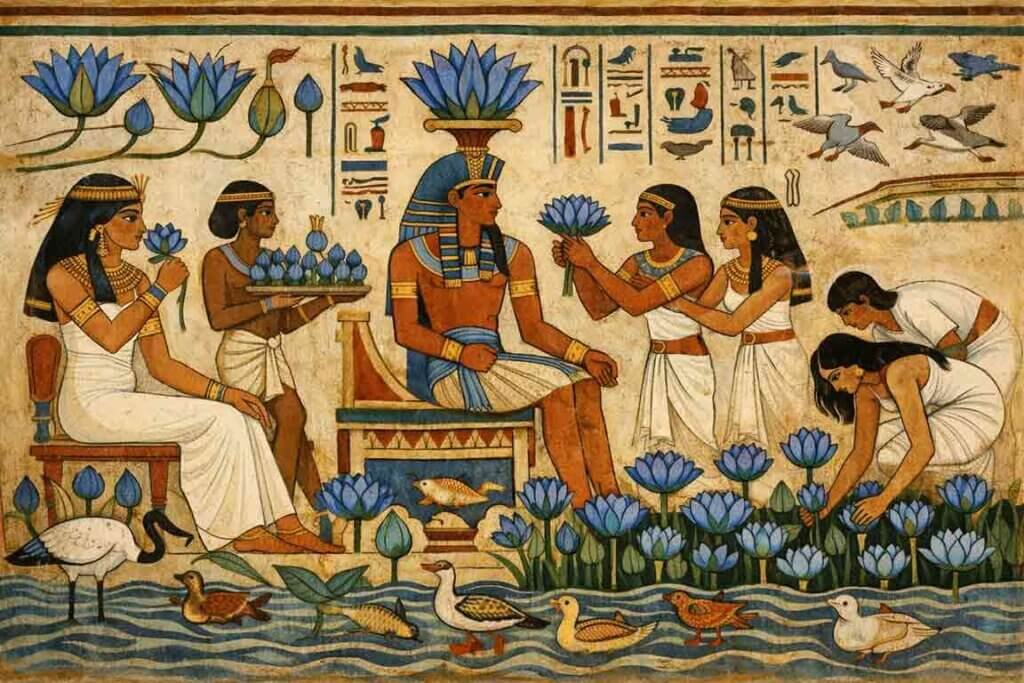
Some of the most instructive paintings come from New Kingdom tombs dating roughly between 1550 and 1070 BCE. In these banquet scenes, elite Egyptians are shown seated at elaborate feasts while servants and musicians entertain them. What stands out is how consistently the blue lotus appears in the hands of guests, pressed directly to the nose, or floating in vessels of wine.
The tomb of Nebamun in Thebes, whose fragments now reside in the British Museum, offers one of the most vivid examples. Guests at a banquet are depicted in a state of relaxed celebration, their bodies loosely rendered in contrast to the more rigid postures associated with formal religious imagery. Several figures hold blue lotus flowers directly beneath their noses, inhaling them. Others have the flowers resting in their wine cups or held loosely in their hands. This is not incidental. Egyptian artists used compositional emphasis to signal importance, and the lotus is centered, prominent, and repeated throughout these scenes.
The Role of Servants in Distributing the Lotus
Another recurring motif is the servant or attendant who actively distributes blue lotus flowers to guests. In multiple tomb paintings across different burial sites, we see a pattern: a servant approaches a seated, often wealthy figure and presents them with a lotus bloom. The recipient almost always leans slightly forward or raises the flower immediately to the nose. This gesture of active inhalation is too specific and too consistent to be symbolic alone. It suggests that smelling or inhaling the scent of the flower was itself a meaningful act, likely one that carried real sensory or physiological significance.
Modern pharmacological research has confirmed that Nymphaea caerulea contains aporphine, a mild psychoactive alkaloid, as well as nuciferine, which produces sedative and euphoric effects. Inhaling the flower at close range, particularly in a warm environment surrounded by wine, incense, and music, would have created a layered sensory experience that the Egyptians clearly valued enough to memorialize on their eternal walls.
Blue Lotus in Funerary Ritual Paintings
The Symbolism of Rebirth and the Sun God
The blue lotus carries specific cosmological weight in Egyptian theology. According to one creation myth, the world began when a great blue lotus rose from the primordial waters of Nun and opened its petals to reveal the infant sun god Ra. This origin story gave the lotus its enduring association with creation, solar energy, rebirth, and the emergence of life from darkness.
In funerary contexts, this symbolism became directly useful. Tomb paintings in the Valley of the Kings and elsewhere show the deceased holding or wearing blue lotus blossoms in scenes that explicitly reference resurrection. The logic was elegant: just as the lotus rises daily from the water and opens with the sunrise, the deceased soul would rise from death into new life. The lotus was a visual prayer, a botanical argument for immortality painted directly onto the walls of eternity.
The Book of the Dead Connections
Several papyri associated with the Book of the Dead contain vignettes in which the deceased is shown transforming into a lotus or emerging from within one. Spell 81A is sometimes called the “Spell for Transforming into a Lotus” and asks that the deceased be allowed to become the flower itself. While this text is not a tomb painting, the imagery in these papyri shares visual language with painted tomb traditions, and the two inform each other.
When we see a blue lotus held in a tomb painting, we are therefore seeing something that exists simultaneously in multiple registers: as a plant with real effects on the human body, as a religious symbol of rebirth, and as a marker of elite cultural practice. The Egyptians did not appear to separate these meanings. For them, the pharmacological effect of the flower and its spiritual symbolism were probably part of the same unified experience.
What the Tomb Paintings Cannot Tell Us Directly
The Limits of Visual Evidence
It would be dishonest to claim that tomb paintings alone prove recreational or ritual psychoactive use of the blue lotus in a way that satisfies modern scientific standards. Egyptian artists worked within rigid conventions, and images were often highly standardized. A figure holding a lotus might be repeating an established compositional formula rather than documenting actual behavior. This caveat is important.
However, the botanical evidence, the pharmacological data, and the sheer consistency of the imagery all point in the same direction. When you combine the tomb paintings with physical evidence of lotus garlands found in tombs, traces of lotus residue in funerary wine vessels, and the written mythology surrounding the flower, the overall picture becomes far more persuasive than any single line of evidence on its own.
Why No Explicit Text About the Effects Exists
One of the great frustrations in this area of research is that the Egyptians never wrote what we might call a pharmacological manual. They did not produce a text that says, in plain terms, “we used the blue lotus because it makes you feel a certain way.” Egyptian written culture was deeply conservative and formulaic, particularly around religious subjects. The effects of sacred plants were probably understood as experiential knowledge passed through ritual practice, not something to be explained in writing.
This means we are always reading the tomb paintings somewhat obliquely, inferring meaning from context, repetition, and the surrounding evidence of material culture. But this is not so different from how historians approach many ancient subjects. The absence of an explicit text does not mean the experience did not exist. It means the Egyptians communicated it differently, through image, symbol, and ceremony.
The Lotus in Offerings to the Gods
Painted Offering Tables and Temple Connections
Many tomb paintings include scenes of the deceased making offerings to gods, and blue lotus flowers appear prominently among these gifts. Osiris, the god of the dead and resurrection, is frequently shown receiving lotus offerings. Hathor, goddess of love, music, and altered states, appears in contexts where the lotus is particularly concentrated. The association between Hathor and the blue lotus is significant because Hathor was also closely linked with wine and with rites that involved deliberate sensory expansion.
In some temple paintings and tomb walls, worshippers are shown holding lotus blossoms toward the faces of divine statues. This mimics the same gesture seen in the banquet scenes, where guests hold the flower to their own noses. The movement collapses the distance between sacred and secular use. Whether you were offering the flower to a god or inhaling it yourself at a feast, the gesture and the plant remained consistent.
Ritual Contexts for Altered States
There is a broader body of evidence suggesting that ancient Egyptian religious practice was not always sober. Festivals associated with Hathor, particularly those at Dendera, involved deliberate intoxication as a form of divine communion. Texts refer to worshippers becoming “beautifully drunk” in the presence of the goddess. If alcohol-induced states were considered appropriate for certain religious experiences, it is entirely consistent that a plant producing mild euphoria and visual softening would also have a sacred role.
The tomb paintings capture the afterlife that Egyptians hoped to enjoy, and the presence of the blue lotus in these visions of eternal existence tells us that the flower was associated not just with earthly pleasure but with divine experience itself.
Modern Scientific Confirmation of What the Paintings Suggest
Pharmacological Research on Nymphaea Caerulea
Research published in peer-reviewed journals has confirmed that Nymphaea caerulea contains biologically active compounds including aporphine and nuciferine. Aporphine acts on dopamine receptors and produces mild psychoactive effects including euphoria and mild hallucination at sufficient concentrations. Nuciferine has sedative and antispasmodic properties. Neither compound is dangerous in the quantities likely consumed through inhalation of the flower or infusion in wine, which aligns with the apparently casual and recreational contexts shown in tomb paintings.
Some researchers have also pointed to the presence of antioxidants and anti-inflammatory compounds in the plant, suggesting it had broader medicinal uses consistent with Egyptian medical papyri, which mention lotus preparations for various conditions.
Archaeological Residue Analysis
Physical evidence from Egyptian burial sites has added another dimension to the painted record. Analysis of residues in ceramic vessels from certain burial contexts has detected compounds consistent with lotus infusion alongside wine. Garlands made from blue lotus flowers have been found preserved in tombs, including in the tomb of Tutankhamun, where they were placed directly on the young king’s body. This physical presence of the plant in a space explicitly designed to facilitate the soul’s journey into the afterlife is striking confirmation that the lotus played a real ceremonial role beyond artistic convention.
Reading the Full Picture
How to Approach Egyptian Lotus Imagery Today
The most accurate reading of blue lotus imagery in Egyptian tomb paintings is one that resists flattening the evidence into a single explanation. The lotus was simultaneously a beautiful flower, a pharmacologically active plant, a symbol of solar rebirth, a marker of elite social identity, and a gateway metaphor for the soul’s transformation. These meanings coexisted and reinforced each other.
When a tomb painting shows a nobleman pressing a blue lotus to his nose while a servant fills his wine cup, that image is doing multiple things at once. It is showing us what an elite Egyptian wanted his eternal existence to look like. It is signaling his social status through access to luxury goods. It is invoking the cosmological power of a sacred plant. And it is quite possibly documenting a real practice that produced real effects on the human body, effects that the Egyptians experienced as beautiful, spiritual, and worth memorializing forever.
Why This Matters for Our Understanding of Ancient Egypt
Recognizing the full complexity of blue lotus use in ancient Egypt matters because it corrects a longstanding tendency to sanitize ancient religion into pure abstraction. Egyptian spiritual life was embodied, sensory, and deeply material. The gods were fed, clothed, and anointed. Worshippers brought real food, real flowers, and real wine. The experience of the sacred was something you tasted, smelled, and felt.
The blue lotus was central to this embodied religion precisely because it sat at the intersection of the physical and the transcendent. Its scent was pleasurable. Its compounds shifted perception. Its mythology pointed to creation and rebirth. In a civilization obsessed with defeating death and achieving eternal life, a flower that made you feel closer to the divine while simultaneously symbolizing resurrection was not just useful. It was practically sacred.
Conclusion
Ancient Egyptian tomb paintings are not simply decorations or pious formulas frozen in pigment. They are documents of an entire civilization’s deepest hopes, most cherished pleasures, and most sophisticated religious thinking. The blue lotus appears in these paintings because it mattered, in ways that were physical, spiritual, aesthetic, and pharmacological all at once.
What the tomb paintings can tell us about blue lotus use is substantial: that it was widely practiced across social contexts from elite banquets to divine offerings, that the act of inhaling the flower was deliberate and valued, that the plant was connected to the most important theological concepts in Egyptian thought, and that Egyptian culture saw no contradiction between pleasure and the sacred. What the paintings cannot tell us, we fill in with botanical science, archaeological residue analysis, and careful attention to the full texture of Egyptian cultural life. Together, these lines of evidence paint a portrait of a civilization that understood the blue lotus not as a simple flower but as a living connection between the human and the divine, between the world of the living and the eternal world beyond.
Frequently Asked Questions
1. Did ancient Egyptians actually use blue lotus as a drug?
Evidence strongly suggests yes. The blue lotus (Nymphaea caerulea) contains aporphine and nuciferine, compounds that produce mild euphoria and sedation. Tomb paintings consistently show Egyptians inhaling the flower directly, and residue analysis of ancient vessels has found traces consistent with lotus-infused wine.
2. What do tomb paintings specifically show about blue lotus use?
Banquet scenes in New Kingdom tombs repeatedly depict guests holding blue lotus flowers directly to their noses while drinking wine. Servants are also shown actively distributing the flowers to seated guests, suggesting a structured and intentional ritual around its use rather than casual decoration.
3. Was blue lotus use religious or recreational?
It appears to have been both simultaneously. Egyptians did not sharply separate pleasure from the sacred. The flower appeared at elite feasts and in offerings to gods like Osiris and Hathor, suggesting its effects were considered spiritually meaningful as well as physically enjoyable.
4. Has the blue lotus been found physically in Egyptian tombs?
Yes. Preserved blue lotus garlands were discovered in the tomb of Tutankhamun, placed directly on his body. This physical presence confirms the flower held genuine ceremonial importance beyond its appearance in painted art.
5. Why did Egyptians connect the blue lotus to rebirth?
Egyptian mythology held that a blue lotus rose from the primordial waters at the moment of creation, revealing the infant sun god Ra. Because the flower also opens with the sunrise each day, it became a powerful symbol of renewal, resurrection, and the soul’s journey into eternal life.