The ancient Egyptians were not just building pyramids and mapping stars. They were also perfecting one of the most sophisticated wellness rituals the world has ever seen, and it involved a strikingly beautiful flower that grew along the banks of the Nile. The blue lotus flower, known scientifically as Nymphaea caerulea, was not simply a decorative motif carved into temple walls. It was a sacred plant, a ritual intoxicant, a healing agent, and a symbol of divine rebirth. Long before modern wellness brands started printing it on supplement bottles, Egyptian pharaohs were soaking in it, drinking it, and burning it as incense in ceremonies that touched every corner of their civilization.
This is the story of how a flower became a philosophy, and why the ancient world understood something about botanical medicine that we are only beginning to rediscover.
What Is Blue Lotus and Why Did Ancient Egyptians Revere It?
The blue lotus flower is a water lily native to the Nile Delta and parts of East Africa. It blooms at dawn and closes at dusk, a natural rhythm that made it a powerful symbol of the sun, creation, and the cycle of life and death in Egyptian cosmology. The Egyptians associated it closely with Nefertem, the god of healing, beauty, and the first sunrise, who was often depicted rising from a blue lotus at the beginning of time.
What made blue lotus more than just a pretty symbol was its chemistry. The flower contains two primary psychoactive compounds: nuciferine and apomorphine. Nuciferine acts as a dopamine antagonist and has calming, mildly sedative effects. Apomorphine is a non-selective dopamine agonist that can produce feelings of euphoria and heightened sensory awareness. Together, these compounds create a mild psychoactive experience, one that ancient Egyptians understood intimately even without modern pharmacology.
The Role of Blue Lotus in Egyptian Spiritual Life
Egyptian religious ceremonies were deeply sensory experiences. Priests and worshippers used scent, sound, color, and altered states of consciousness to communicate with the divine. Blue lotus was central to this practice. Wall paintings in the tombs of Luxor, Karnak, and the Valley of the Kings repeatedly show figures holding blue lotus flowers to their noses, inhaling the scent in ritual contexts. The flower appears at banquets, funerary rites, and offerings to the gods with such frequency that archaeologists had to take its symbolic weight seriously.
The connection between blue lotus and the afterlife was particularly strong. In the Book of the Dead, blue lotus is mentioned as a transformative plant that helps the soul navigate the underworld. The scent itself was believed to carry spiritual power, opening the mind to visions and divine communication.
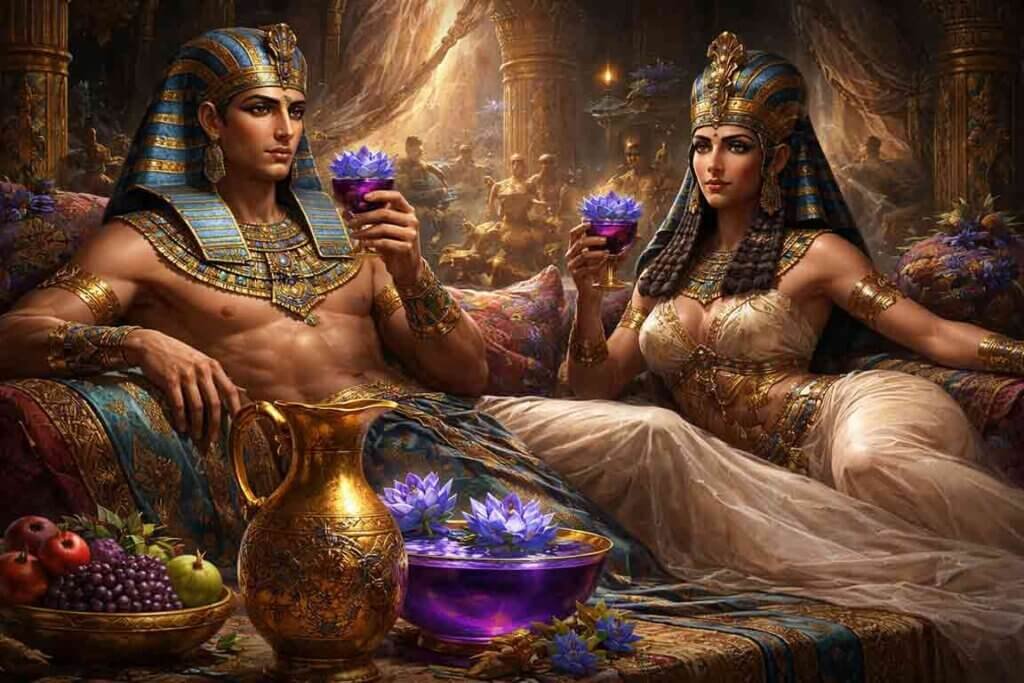
How Pharaohs Actually Used Blue Lotus Wine
The most famous method of consumption in ancient Egypt was blue lotus wine. This was not simply a matter of dropping a few petals into a cup of wine. The preparation was a deliberate, careful process that speaks to a sophisticated understanding of plant chemistry.
Dried blue lotus flowers were steeped in grape wine for several days, sometimes weeks. The alcohol acted as a solvent, extracting the active compounds from the petals far more efficiently than water alone. The resulting infusion was then consumed during religious ceremonies, royal banquets, and healing rituals. Some historical accounts and artistic depictions suggest that this wine was reserved for the elite, including pharaohs, priests, and nobles, making it not just a spiritual tool but a marker of status and power.
Did Pharaohs Really Bathe in Blue Lotus Wine?
This is where the story takes a particularly extraordinary turn. Several historical sources and Egyptological studies suggest that pharaohs and members of the royal court did not just drink blue lotus wine. They bathed in it. Ritual bathing was a significant part of Egyptian religious practice, and adding botanical preparations to bath water was not unusual. The skin is a remarkably effective organ for absorbing certain compounds, and soaking in a concentrated blue lotus infusion would have allowed nuciferine and apomorphine to enter the bloodstream transdermally.
This practice was likely part of coronation rituals, purification ceremonies, and preparations for divine communication. The idea was not merely physical cleanliness but a kind of spiritual saturation, immersing the body in sacred plant medicine so that the boundary between the human and the divine could become more permeable.
The Chemistry Behind the Ancient High
Modern science has begun to catch up with what the Egyptians knew experientially. Nuciferine, one of the key compounds in blue lotus, has been studied for its antipsychotic and calming properties. It interacts with serotonin and dopamine receptors in ways that promote relaxation without heavy sedation. Apomorphine is actually used in modern medicine as a treatment for Parkinson’s disease and erectile dysfunction, suggesting the Egyptians may have also used blue lotus as a sexual enhancer, a claim supported by several erotic papyri and temple carvings that associate the flower with desire and fertility.
The combination of wine and blue lotus was chemically intelligent. Alcohol not only extracts and concentrates the active compounds but also has its own synergistic effect on the central nervous system, amplifying the euphoric and relaxing properties of the plant. What ancient Egyptians stumbled upon through centuries of observation and ritual was essentially a pharmacologically informed herbal preparation.
Blue Lotus vs. Modern Adaptogens: What’s the Difference?
Today’s wellness market is flooded with adaptogens, herbs and plant extracts that claim to reduce stress, enhance mood, and support cognitive function. Ashwagandha, rhodiola, lion’s mane mushroom, and dozens of others line the shelves of health food stores. Blue lotus has recently joined this category, sold as a tea, tincture, vape product, and supplement.
The key difference between ancient use and modern use is context and intention. The Egyptians used blue lotus within a rich ceremonial framework. The setting, the ritual, the community, the spiritual purpose, all of these shaped the experience. Modern wellness culture tends to strip plants from their context and deliver them as isolated supplements, which may miss the full picture of how these plants work. Ritual, intention, and communal use are not just spiritual fluff. They have measurable effects on the nervous system through mechanisms like expectation, social bonding, and the placebo effect working in conjunction with the plant’s actual chemistry.
Blue Lotus in Art, Mythology, and Medicine
The footprint of blue lotus across ancient Egyptian culture is enormous. It appears in over a thousand known artworks spanning more than two millennia. It was offered to gods in temples, placed on the bodies of the dead, woven into garlands, and depicted growing out of the primordial waters of creation.
In medicine, the Ebers Papyrus, one of the oldest surviving medical texts in the world, dated to around 1550 BCE, mentions lotus preparations in the context of treating anxiety, pain, and digestive issues. This positions blue lotus not as a purely recreational or spiritual plant but as part of a broad pharmacopeia that Egyptian physicians drew from with considerable sophistication.
Blue Lotus and Sexual Wellness in Ancient Egypt
One of the more surprising aspects of blue lotus history is its association with sexual health and desire. Apomorphine, as mentioned, is a known sexual stimulant. Egyptian texts and artworks suggest that blue lotus was used to enhance sexual experiences, support fertility, and address what we might today call sexual dysfunction. Given that apomorphine is currently prescribed for erectile dysfunction, the ancient Egyptians were essentially using a natural version of a compound that modern medicine independently rediscovered thousands of years later.
This parallel is not coincidental. It is evidence of careful, cumulative observation over generations. The Egyptians were watching how plants affected human bodies and behavior, recording those observations in ritual and art, and passing the knowledge down through priestly lineages and medical schools.
What Happened to Blue Lotus Knowledge?
The fall of ancient Egyptian civilization did not happen overnight, but as Greek and later Roman cultural influence spread, many indigenous Egyptian practices were absorbed, suppressed, or simply forgotten. The introduction of Christianity and later Islam into North Africa further changed the cultural landscape, and plant medicines associated with pagan ritual fell out of favor or went underground.
Blue lotus survived in fragments, preserved in the carvings of temples too massive to tear down, in papyri that ended up in European museum collections, and in the folk knowledge of communities living along the Nile. It was not until the 20th century, as Egyptology matured as a discipline and ethnobotany began taking traditional plant use seriously, that the significance of blue lotus started to be properly reconstructed.
The Modern Rediscovery of Blue Lotus
The current wellness industry’s interest in blue lotus is part of a broader cultural movement toward ancestral health practices. People are increasingly skeptical of synthetic pharmaceuticals and drawn to plant medicines with long histories of human use. Blue lotus fits this appetite perfectly. It is visually stunning, historically fascinating, gently psychoactive, and backed by a growing body of scientific literature on its active compounds.
Products range from blue lotus tea and herbal tinctures to aromatherapy preparations and even vape products containing blue lotus extract. Some companies have leaned heavily into the Egyptian branding, invoking pharaohs and temple rituals to market their products. Others take a more clinical approach, focusing on the anxiolytic and mood-enhancing properties of nuciferine.
Is Blue Lotus Safe to Use Today?
For most healthy adults, blue lotus is considered generally safe when used in moderate amounts. It is not a controlled substance in most countries, though regulations vary and are worth checking depending on where you live. The effects are mild compared to stronger psychoactive plants, typically described as a gentle sense of calm, slight euphoria, and enhanced sensory awareness.
That said, anyone taking pharmaceutical medications, particularly those affecting dopamine or serotonin systems, should consult a healthcare provider before using blue lotus, given the pharmacological activity of its compounds. Pregnant women are generally advised to avoid it. The fact that it has a 3,000-year history of human use is reassuring, but it is not a substitute for individual medical advice.
Why the Pharaohs Were Ahead of Their Time
Looking back at the Egyptian use of blue lotus, what is most striking is not just the sophistication of the practice but the holistic framework within which it was embedded. The Egyptians understood that healing and consciousness were inseparable. They understood that plants could serve as bridges between the physical and the spiritual. They understood that the body could be a vehicle for transcendence, and that preparing it carefully with the right plants, rituals, and intentions was not superstition but technology.
Modern neuroscience increasingly supports the idea that set and setting powerfully shape how psychoactive substances affect us. The Egyptian ceremonial context, with its elaborate rituals, beautiful settings, communal participation, and clear spiritual intention, was essentially an advanced application of this principle. The pharaohs were not just getting high in their baths. They were conducting carefully calibrated experiments in consciousness that happened to work.
Conclusion: A Flower That Never Really Left
The blue lotus is having a moment in the wellness world, but it never truly disappeared. It waited in hieroglyphs and papyri, in the chemistry of a flower that still blooms along the Nile, for the modern world to catch up with what the ancient Egyptians already knew. The pharaohs bathed in blue lotus wine not because they were primitive or superstitious but because they had accumulated thousands of years of knowledge about how this remarkable plant interacted with the human body and spirit.
As wellness culture continues to look to the ancient world for inspiration, blue lotus stands out as one of the most compelling rediscoveries of our time. Not because it is exotic or trendy, but because it represents a genuinely sophisticated tradition of plant medicine that bridges body, mind, and spirit in ways that modern science is only beginning to fully appreciate. The next time you see blue lotus on a wellness product label, remember that you are not buying into a new trend. You are touching something that was sacred for thousands of years before the first supplement company ever existed.
Frequently Asked Questions
Q1: What does blue lotus actually do to your body?
Blue lotus produces mild euphoria, relaxation, and heightened sensory awareness due to its two active compounds, nuciferine and apomorphine, which interact with dopamine and serotonin receptors in the brain.
Q2: Is blue lotus legal to use today?
Yes, blue lotus is legal in most countries and is not classified as a controlled substance. However, regulations vary by region, so it is always worth checking local laws before purchasing or consuming it.
Q3: How did ancient Egyptians consume blue lotus?
The most common methods were drinking blue lotus-infused wine, inhaling the scent during rituals, and bathing in concentrated floral preparations during royal and religious ceremonies.
Q4: Can blue lotus be used alongside other medications?
Not without caution. Because blue lotus interacts with dopamine and serotonin systems, it may interfere with certain psychiatric or neurological medications. Always consult a healthcare provider before combining it with any prescription drugs.
Q5: Is modern blue lotus the same plant the Egyptians used?
Yes. Nymphaea caerulea, the blue water lily native to the Nile Delta, is the same species revered by ancient Egyptians. It still grows in the region today and contains the same psychoactive compounds documented in historical and archaeological records.